Guernsey Airport Joins Forces with Airport Coordination Limited in New Data Collection Partnership

Airport Coordination Limited signs a three-year agreement to deliver Level 1 data collection services, supporting Guernsey Airport’s long-term growth and regional connectivity.

Airport Coordination Limited (ACL) is pleased to announce a new partnership with Guernsey Airport (GCI), commencing 1 October 2025. Under this three-year agreement, ACL will deliver Level 1 data collection services, supporting Guernsey Airport’s operational planning and future growth.

Guernsey Airport is a vital regional gateway connecting the Channel Islands to the UK and Europe, serving 700,000 passengers and around 29,000 aircraft movements in 2024. As the airport looks ahead to the future, it is focused on enhancing the passenger experience, supporting route development, and increasing commercial revenue.

ACL, with its proven expertise in data collection and facilitation services, including its longstanding support for Jersey Airport, is well positioned to assist Guernsey in achieving these goals by providing operational insights that optimise capacity and inform strategic planning.

Richard Thomasson, Guernsey Airport Director, said:

“Our partnership with ACL will provide greater insight into passenger and aircraft movements, allowing us to better understand airport capacity and improve operational efficiency accordingly.

“We are pleased to join ACL’s ever-growing network of airports across the British Isles, including many in our own route network. We look forward to benefitting from the increased coordination this will bring.”

Neil Garwood, Chief Executive Officer at ACL, said:

“We’re delighted to welcome Guernsey Airport to ACL’s growing network of UK and Channel Islands airports. This partnership is a celebration of the Channel Islands’ vital role in British aviation, and we’re proud to support Guernsey as it strengthens its connectivity and prepares for future growth. ACL has provided facilitation services to Jersey Airport for many years, and we’re excited to now extend our expertise to Guernsey. Together, we’re helping to build a more integrated and resilient regional aviation landscape.”

About ACL

Airport Coordination Limited is the world’s first independent airport slot coordinator. Based near London Heathrow Airport in Staines-upon-Thames, ACL provides world-leading coordination, schedule facilitation, and data collection services to airports around the world. With Guernsey Airport joining its network, ACL now supports nearly 80 airports globally, solidifying its position as the largest independent airport slot coordinator in the world.

Media Contact

Alison Chambers
Emerald Media
alison.chambers@emeraldmedia.co.uk



Cornwall Airport Newquay Partners with Airport Coordination Limited to Enhance Operations

Airport Coordination Limited (ACL) enters a three-year contract providing data collection services at Cornwall Airport Newquay

ACL is pleased to announce that it has signed a new three-year contract with Cornwall Airport Newquay (NQY), starting in December 2024. Under this agreement, ACL will provide data collection services, ensuring more efficient and seamless operations as Newquay continues to grow as a key regional hub.

NQY serves a mix of domestic and international routes, handling over 400,000 passengers and over 20,000 aircraft movements in 2023-24. As demand for regional and leisure travel continues to rise, the airport has become a key driver of economic growth and connectivity for Cornwall, making this partnership with ACL crucial to support its ongoing expansion and operational efficiency.

Amy Smith, Head of Commercial at Cornwall Airport Newquay, said,

“We’re excited to partner with Airport Coordination Limited as we work to expand our route network and enhance our operations. This collaboration comes at a crucial time, as demand for travel to and from Cornwall grows. ACL’s expertise in data collection and operational efficiency will support our mission to deliver a seamless experience for passengers and airlines alike, strengthening our position as a key regional gateway.”

Neil Garwood, Chief Executive Officer at ACL, said

“We are thrilled to begin our partnership with Cornwall Airport Newquay, an essential gateway connecting Cornwall and South-West England to the wider world. This three-year agreement reflects our shared commitment to optimise capacity while maintaining a personalised, high-quality experience for every passenger and airline. We are proud to support Cornwall Airport Newquay’s mission of improving connectivity and driving growth in this beautiful part of the UK.”

About ACL

Airport Coordination Limited is the world’s first independent airport slot coordinator. Based near London Heathrow Airport in Staines-upon-Thames, ACL provides world-leading coordination, schedule facilitation, and data collection services to airports around the world. With Newquay Airport joining its network, ACL now supports 76 airports worldwide, including 27 in the UK, solidifying its position as the largest independent airport slot coordinator in the world.

For more information, visit: www.acl-uk.org

Media Contact

Alison Chambers
Emerald Media
alison.chambers@emeraldmedia.co.uk
Stepping into Summer: ACL’s Summer 23 Outlook

The sun is shining, leaves are on the trees and new life is sprouting everywhere. Spring is finally here and for Airport Coordination Limited (ACL) that means the Summer season is now in swing. So what does ACL’s data show us about how airlines are gearing up for their busiest time of year?

Recovery continues to be at the forefront of the industries minds and the Secretary of State for Transport appears to be in agreement. The government issued guidance on Summer 2023 acknowledges the pandemic continues to impact air traffic and that the road to recovery is ongoing.

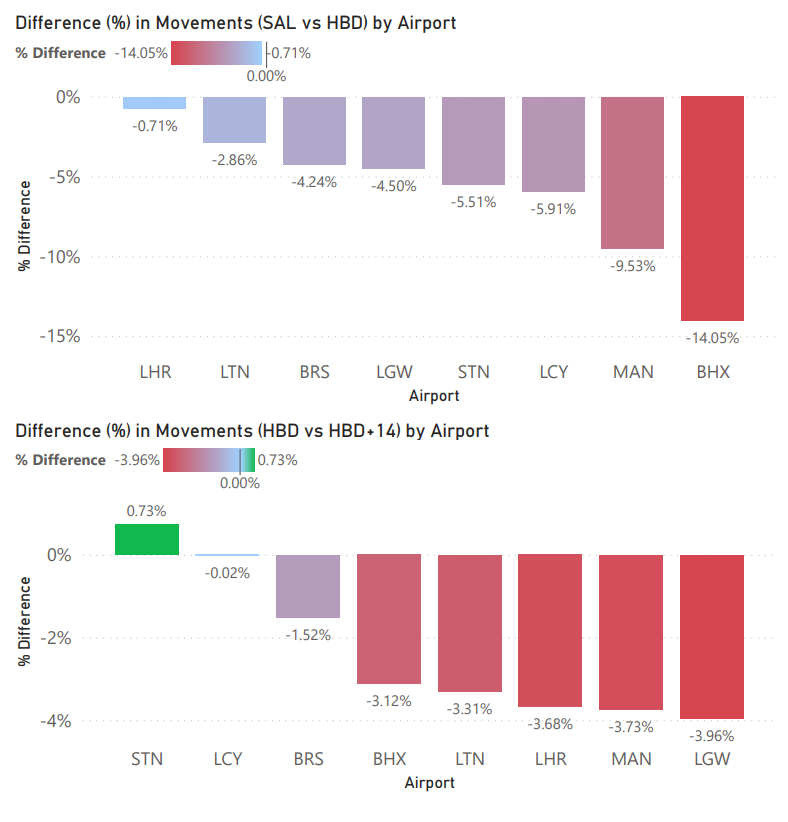
ACL’s position as the UK’s designated slot coordinator provides unique insight into UK Level 3 airports, and the impact of the alleviation offered for the Summer 2023 season. Airlines had the opportunity to gain alleviation on up to 5% of their historic slots, which were cancelled between the hand-back deadline (HBD – 01 February 2023) and 14 February 2023 (HBD+14).


Across the UK Level 3 network, London Heathrow Airport saw the smallest reduction in slots between initial coordination (SAL – 03 November 2023) and the time of the HBD, with a slots hand-back rate of 0.71%. In contrast, Birmingham Airport saw the greatest rate of hand-backs, observed at 14.05%. This was also the case between SAL and HBD +14 (-4.73% & -16.73% respectively). Overall ACL observed a hand back rate of just under 5% at the time of the HBD, increasing to 7.5% at HBD +14.

During the 14 days period after hand backs, London Stanstead Airport surprisingly saw minor growth in the airport schedule with ITA Airways adding over 1,300 slots and Jet2 a further 250 more than offsetting any reduction. London Gatwick saw the greatest reduction in slots (3.96%) with easyJet making up more than half of this reduction. 

In general we didn’t see carriers taking up their full 5% allowance between HBD and HBD+14, only 2.86% was taken on average across Level 3 airports. Looking back at the similar process for Winter 22/23 season where carriers could hand back 10% of slots for 7 days after HBD they handed back around 8%. Read into this what you will, however this could be read as a sign that airlines are ready to operate more in S23 and start to get back to S19 levels.

The Real Facts Behind Summer 2022

ACL go back to the raw data to reveal what really happened to UK flight recovery in the Summer 2022 season.

Following two years of the Covid pandemic impacting the ability to travel, there was hope that Summer 2022 (S22) would see recovery. Regulators moved utilisation targets closer to the standard 80/20, passengers were signalling a desire to get travelling, and recruitment across the industry was in full swing.

What was not clear at the start of the season was the impact that the resource shortage was going to have on the ability to satisfy the returning demand. Media reports were soon appearing across all channels showing long queues as passengers were processed through airports. While reports of on the day cancellations lead to further inconvenience for the travelling public. With the industry tying to meet demand, recover lost revenue from previous years and ensure they didn’t lose the historic entitlement to slots, the pressure was on to operate.

The UK Government took the unusual step to intervene mid-season by legislating at speed to provide the pressure release the industry required.  Alleviation from the already reduced utilisation threshold of 70% was granted for a further 30% of slots held at that point. During the two week return window a total of 45,529 slots were handed back across UK coordinated airports. That equates to 32% of the possible cancellations under the amended Regulation and a 10% reduction in slots for the remainder of the season. Very few airlines made use of the full 30% which lead to London Heathrow mandating further cancellations to reduce demand. This was to ensure a safe operation across the airport.

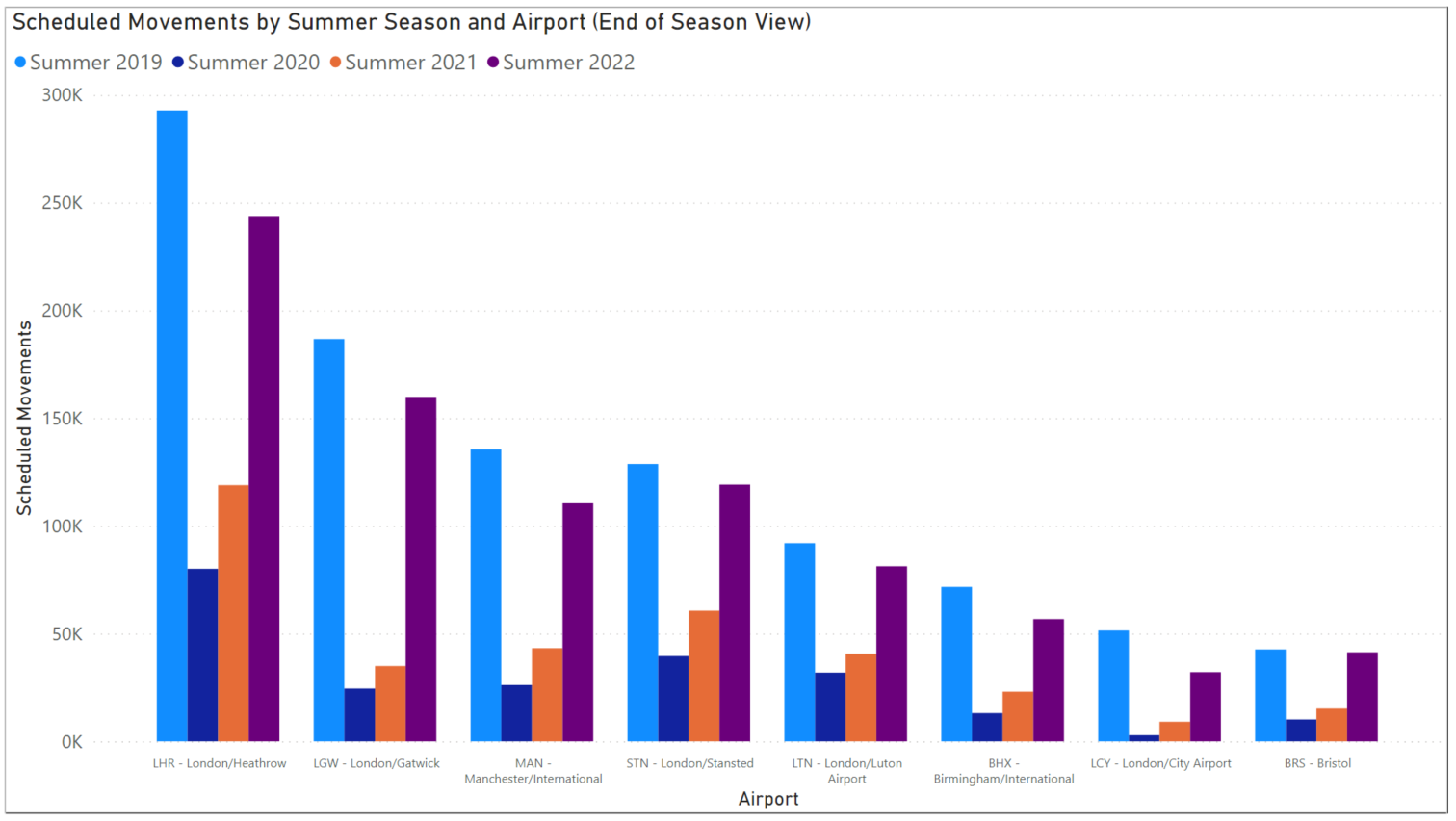
All of the above factors impacted the performance of S22 when compared to the previous three seasons with particular focus on comparison against pre pandemic levels in Summer 2019 (S19).

Note: S19 and S20 seasons were 30 weeks in length, and S21 and S22 seasons were 31 weeks in length. S19 and S20 movement numbers have been normalised to ensure a like for like comparison

As you would expect the movement numbers season on season across the UK’s Level 3 coordinated airports have shown a gradual improvement following the initial shock in Summer 2020 (S20). Despite the strong indication that demand was returning at the initial coordination stage for S22, the impact of resourcing issues and the lingering effect, albeit reducing, of Covid meant that S22 numbers continued to be below that of S19 levels. In our start of the season update, Airport Capacity Analyst, Christakis Christodoulou, reported that scheduled movements across these same airports sat at 4.58% below S19.  https://www.acl-uk.org/news/a-shaky-summer/

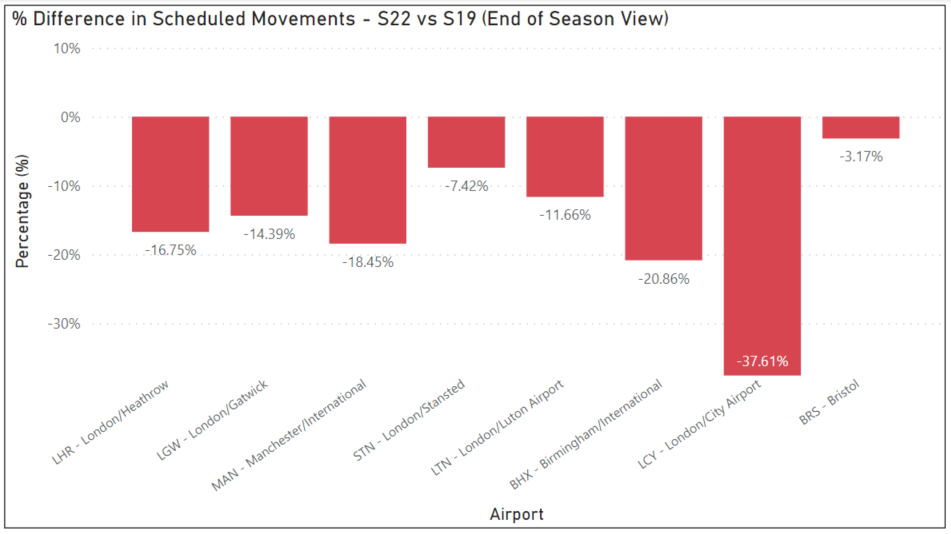
S22 season saw most UK Level 3 airports double their scheduled movements compared to S21, despite the issues experienced which demonstrates the potential strong demand following the Covid-19 pandemic. Out of these airports, London Gatwick Airport (LGW) saw the strongest recovery, with carriers such as British Airways scheduling to operate 13 times more of slots than held in the S21 season. LGW’s biggest operator, easyJet, also contributed to the recovery of the airport, scheduling 3 times as many slots than in the S21 season.

Despite the recovery, S22 did not exceed or meet the same levels of demand which was observed in 2019. London City Airport (LCY), which saw the largest decrease in demand since S19, was significantly impacted in 2020 with the loss of Flybe. Even though the Flybe brand has returned to the sky under new ownership in 2022, the operator has yet to return to LCY. Bristol and London Stansted both recovered to be only single percentage digits behind S19 levels.

All the signs were there for S22 to be far better than materialised. Without the impact of the resourcing issues, we believe we would have been reporting a more positive review of the season. As we move into Summer 2023 (S23) planning, the question remains if such operational disruption will continue to impact recovery. Government has started its consultation of potential alleviation measures for the season. Only when this concludes will we get our first indication of the optimism of the industry.

ACL will continue to report on what we’re seeing from our extensive database of planned flying at UK airports including a summary of initial coordination for S23.

By Head of Commercial and People, Jon Rowell


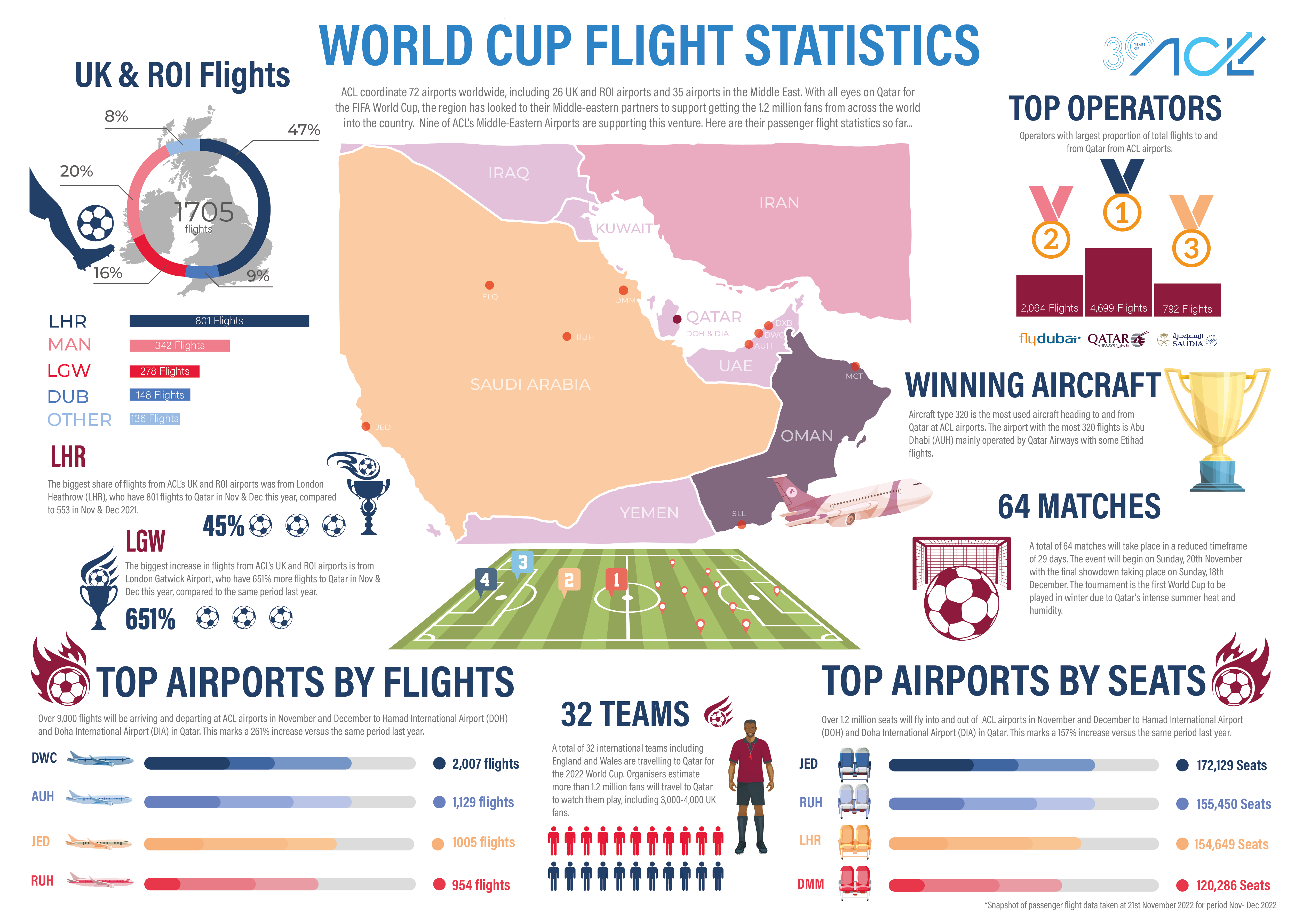
ACL Airports’ World Cup Flight Statistics

Airport Coordination Limited (ACL) coordinate 72 airports worldwide, including 26 UK and Republic of Ireland airports and 35 airports in the Middle East. With all eyes on Qatar for the FIFA World Cup, the region has looked to their Middle-eastern partners to support getting the 1.2 million fans from across the world into the country. Nine of ACL’s Middle-Eastern Airports are supporting this venture.

Here we share our infographic of the passenger flight statistics so far…

Click here for larger PDF view

Did you know?
ACL have a long history of coordinating major international sporting and political events. To find out more, and discover how we can help your airport manage extreme demand, visit our Special Events page – Special Events Coordination

Did you know?
ACL hold all the flight data for slot schedules at our 72 airports, worldwide. Businesses can use this data to support their own planning, operations and analysis. If you would like to know more about our data and get in touch, visit our Data Services page – Data Services


Data analysis by Airport Coordinator, Oliver Thompson. Imagery by Denise Wakeford, Sales and Marketing Lead.


A Shaky Summer

Airport Capacity Analyst, Christakis Christodoulou, explores how the current Summer 2022 season compares with Summer 2019’s pre-pandemic schedule and what this says about schedule volatility and aviation’s hopes of recovery.

In January this year the UK government announced an amendment to the UK slot rules. The change marked a divergence from the widespread alleviation which had become common place during the pandemic and is a step closer to the familiar 80/20 rule which was in place before March 2020. The rule requires all airlines operating at UK Level 3 coordinated airports to operate 70% of their slot series in Summer 2022 (S22) to claim their historic slots for the following 2023 Summer season.

Despite optimism in the demand for travel, the impact of staff shortages, covid case numbers and ongoing travel restrictions, means there is still uncertainty in the aviation market. This is evident in airlines latest slot holdings and the comparisons with Summer 2019 (S19).

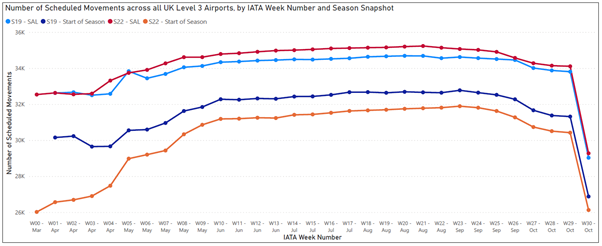
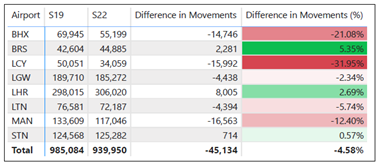
When compared with S19, the start of the S22 season has seen a reduction of 4.58% in scheduled movements across all UK, Level 3 airports. The lowering in demand is driven by a 13% reduction in April as airlines shortened their historic season or returned slots in response to the 70/30 utilisation requirement. As the season progresses the average reduction between start of season 2019 and 2022 is 6.35%. It remains to be seen if carriers will make further reductions as the date of operation approaches.

Figure 1 – Line chart shows the number of scheduled movements by IATA week number and season snapshot across all UK level 3 airports.

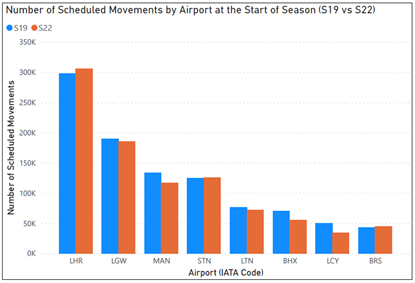
At an airport level, the start of the season comparison shows three out of eight UK Level 3 airports are reporting marginal growth. As a London system, overall movements have declined in S22 compared to S19 with a reduction of over sixteen thousand movements (2.18%) compared to pre-pandemic levels

Figure 2 – Bar chart shows the number of scheduled movements by airport at the start of the Summer 2019 and 2022 seasons.
Figure 3 – Tables shows the difference in scheduled movements by airport between the start of the summer 2019 and summer 2022 seasons.

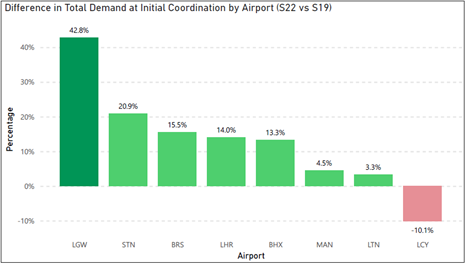
This growth is already a reduction on information captured at initial coordination in November 21, where seven out of eight Level 3 airports showed growth compared to the demand observed at initial coordination for S19.

Figure 4 – Bar chart shows the percentage difference in demand at initial coordination by airport at the start of the Summer 2022 season against the Summer 2019 season.

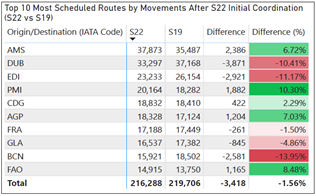
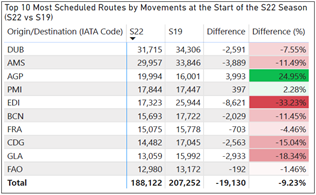
Similarly, five of the top ten most served routes by movements across all Level 3 airports showed growth in November 21 when compared to pre-pandemic levels. Four months later, at the start of the season, eight of the ten routes have seen a decline.

Figures 5 and 6 – Tables showing the top 10 most scheduled routes after S22 initial coordination and start of season respectively.

It is difficult to predict whether any remaining growth will continue during the season. The last two years have demonstrated short-notice changes in restrictions can disrupt planned operations. Whist such issues may be less prevalent, they have been replaced with other operational challenges. Shortages of resources and high levels of covid infections have led to disruption, cancellations, and volatility in airline schedules and airport demand.

While travel remains high on peoples wishlists; the demand for travel appears to be recovering quicker than supply can be delivered. At this stage of the coordination cycle the number of movements are 4.58% below the same snapshot in S19. Whilst we expect this to increase as the seasons progresses, the foundations are still there for growth.

If you would like to view more of our insights and compare how the start of S22 compares with the previous year, please view our start of season reports which can be found here. For more bespoke reporting, or access to ACL’s airport schedules please contact – denise.wakeford@acl-international.com

By Christakis Christodoulou, Airport Capacity Analyst


Signs of Summer

Airport Capacity Analyst, Christakis Christodoulou, looks at ACL’s initial coordination data for Summer 2022 and what this can tell us about the season ahead.

It goes without saying that Covid-19’s impact on the aviation sector has been significant. UK coordinated airports saw an average reduction of 70% in operated flights compared with pre-pandemic levels. Now, as Airport Coordination Limited (ACL) commence the coordination cycle for Summer 2022, we can start to get a view of airline demand in relation to initial submissions before coordination. Some might expect demand to be lower than pre-covid, as aircraft are removed from fleets, crew compliments reduced and consumer travel remaining uncertain. The story is not the case at all airports. Increased demand at this stage can be for many reasons including genuine incremental growth, positioning to exploit opportunities or uncertainty about recovery and future travel restrictions.

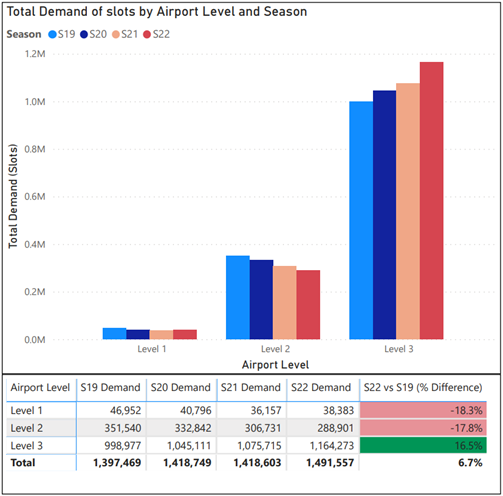
The graph below paints a picture of this divergence. Demand is reduced at Level 1 (data collection) and Level 2 (facilitated) airports, but increases significantly for larger, Level 3 (fully coordinated) airports. Demand activity decreased annually by an average of +7.9% (20,880 movements) at Level 2 airports, while simultaneously increasing by an average of +5.2% (55,099 movements) annually at Level 3 airports. This could be due to the less formal process at facilitated airports and the available capacity and/or lower competition for slots, making permissions easier to obtain as the coordination cycle progresses. Taking all ACL airports, Summer 22 demand has increased by +6.7% (94,088 slots) compared to Summer 2019.

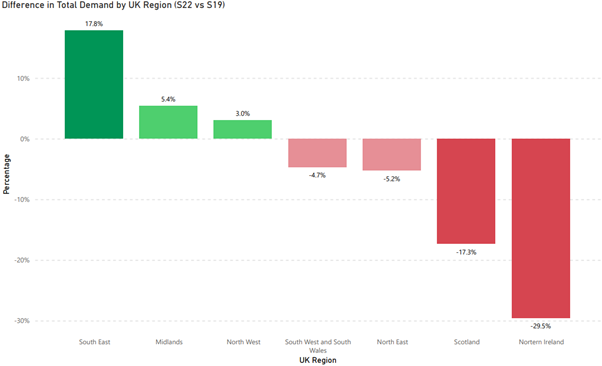
The following graph compares this difference at a regional level, comparing Summer 22 and Summer 19 demand by UK regions.

The South East, which has the highest concentration of Level 3 airports, saw the highest growth. Whereas Northern Ireland saw the greatest reduction. Only time will tell if this is a true reflection on what will materialise. ACL would expect, as the coordination cycle progresses, demand will level up as schedules become finalised.

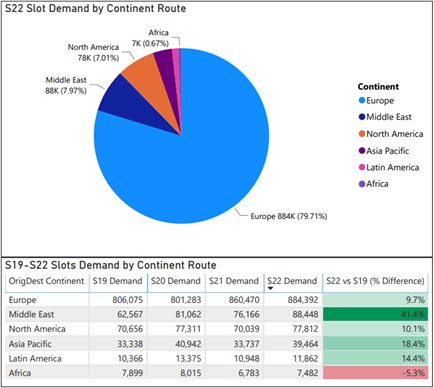
Initial data of the destinations intended to be served shows the UK and Europe accounting for 80% of Level 3 airport slot requests. Comparatively, Africa is the only continent to see a decrease in demand compared to Summer 19 season. While destinations in the Middle East saw the greatest growth in demand.

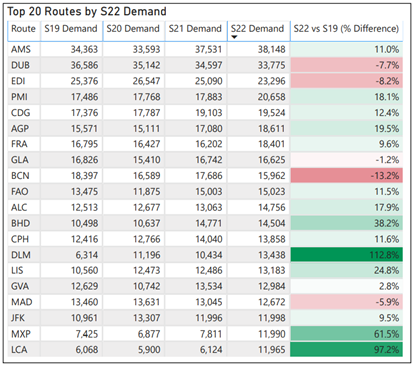
Further analysis identifies which routes are gaining popularity. The table below shows the top 20 destinations demanded during the Summer 22 initial coordination process across all UK Level 3 airports. Mallorca (PMI), Charles De Gaulle (CDG) and Malaga (AGP) are some of the many international routes experiencing an increase in demand. Amsterdam (AMS) is currently the most popular route across the Level 3 airports, facing an increase of 11% compared to pre-pandemic demand.

How accurate are these assessments?

Based on previous seasons, the data quality of initial demand data can vary and depend very much by airport. Demand for some airports tends to be genuine. Conversely, other airports are prone to receiving high demand which eventually falls away.

Demand can fall for various reasons. The coordinator may not be able to give the required time and so the slot becomes unfeasible for the operation. Or the airline may not get the slot at the other end of the route and so cannot complete the operation.

Market demand can also play a role in the eventual services operated. Airlines may seek to improve flexibility by requesting slots to build a pool to choose from as markets change. Similarly, requests may be made to test availability, with operational decisions made at a later stage. This is often common practice when airlines look to enter new markets and there are multiple options for airports in their chosen destinations.

All these examples are permitted under the slot process and with the uncertainty caused by Covid there are probably increased reasons for doing so.

Such high demand may also be misinterpreted. At a time when alleviation for Summer 2022 is still in discussions, many could conclude high demand negates a need for pandemic-related alleviation. Alternatively, it is equally uncertain whether demand at this stage is a product of ongoing uncertainty, justifying alleviation at a market-by-market level.

To answer the question, all data has its merits and a vast majority of demand data will be accurate. There will be a requirement to sensitise the data for planning purposes as history shows not everything planned will materialise and likewise services not currently planned will appear in the schedule. Those using data for planning purposes should be wary of drawing conclusions from a single snapshot. Nonetheless, ACL would urge carriers to return slots they do not intend to operate at the earliest opportunity so they can be reallocated as required by the WASG. Doing so gives airlines on the wait list greater opportunity to gain access or improve schedule optimisation and allows airports to better plan for the season ahead.

By Christakis Christodoulou, Airport Capacity Analyst

30 Years of ACL

This year marks 30 years since ACL began as the World’s first independent slot coordinator. As today marks the start of our next business year, we wanted to share some of our companies highlights, memories past and present, and the expert services ACL offers.

We’ve loved every second spent with our customers. We’re proud of the trust they have placed in us and the determination of our staff to seek the most innovative solutions. From customers who have been with us from the very beginning to our latest newcomers, we’ve loved being your coordinator and we’re excited to serve you for another 30 years…and beyond!

Take a look at our 30th Anniversary page to hear more about our story and 30 years of coordination expertise


The day aviation’s been waiting for: A first-look at Summer flying as the ban on international leisure travel is eased

After 19 weeks without international leisure travel, today marks the day international holidays can finally resume. Following the government announcement of a UK traffic light travel system, we look at how airlines have responded by adapting their summer plans. 

Ongoing travel restrictions have left the UK’s aviation market substantially reduced, with the first 6 weeks of the Summer 2021 (S21) season seeing an 84% decline in traffic versus 2019 (-42.9 million seats). Reductions in Covid-19 cases and the success of the UK’s vaccine programme have given the industry reasons to be optimistic, however international travel restrictions remain the key factor determining when widespread travel will return.

Airlines have been restricted in their ability to plan for the remainder of this summer, with some operators holding substantial volume for June onwards whilst awaiting decisions on which destinations will be feasible to operate. The 7th May announcement on the UK’s traffic light travel system has provided some clarity in the short-term, enabling airlines to identify which routes can operate with viable seat loads in the coming months. This has driven significant schedule change with seat volumes for June reduced by over 25% since the traffic light system announcement. Airlines have cut back flights based on the traffic light categories, providing a far more reliable schedule picture for May and June.

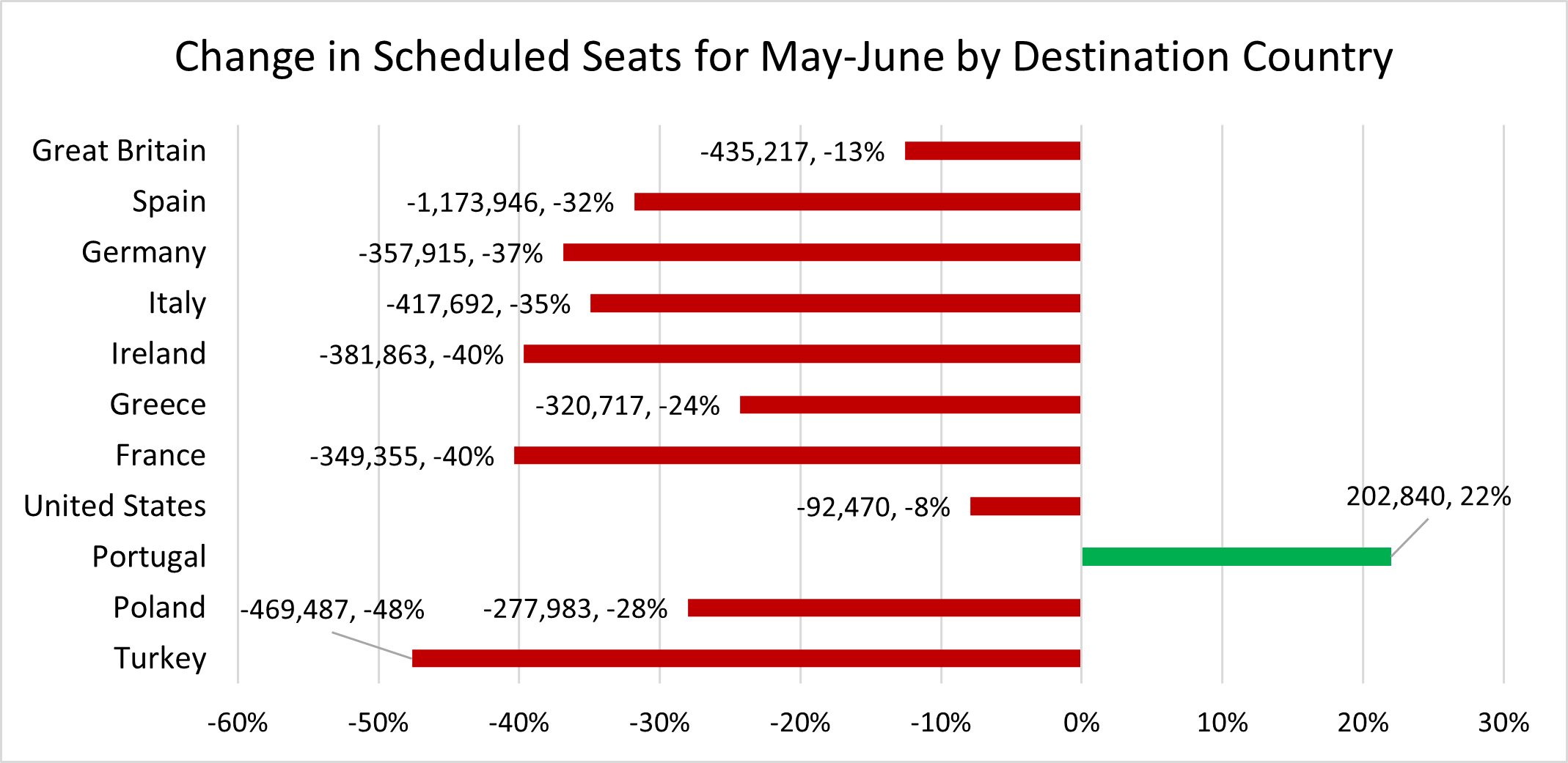
The impact of the government’s system is seen clearly in the changes to slot volume by country, with passenger demand for destinations directly driven by the traffic light system’s travel restrictions. Of the UK’s 20 busiest destinations for May – June, only Portugal has seen an increase in scheduled flights since the announcement, with the other 19 destinations seeing flights reduced or cancelled.


Figure 1 – Change in scheduled seats at ACL UK airports by origin / destination country following traffic light system announcement.


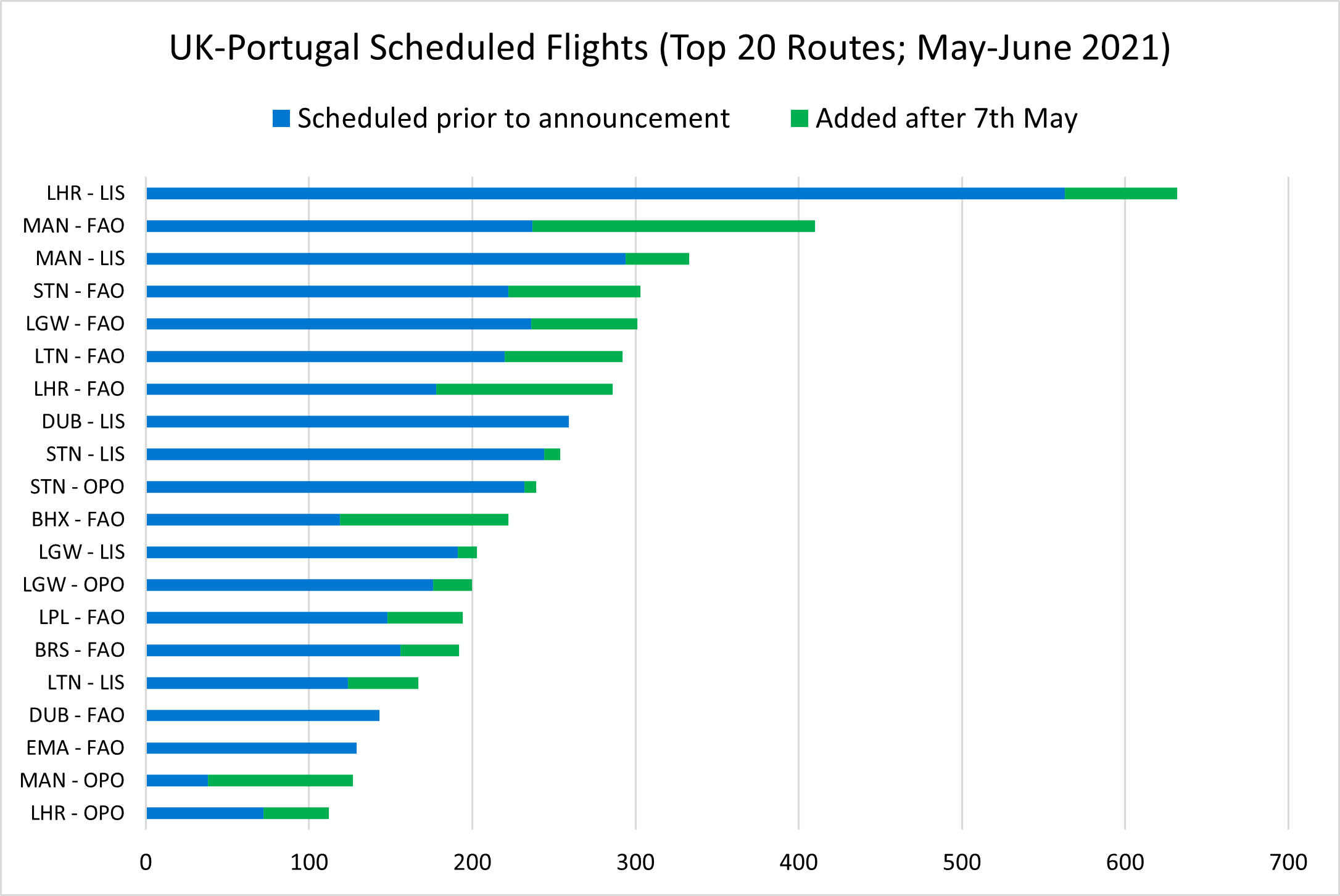
The influence of green-list inclusion on demand is clear; in the week following the announcement of the green-list countries, the number of scheduled flights operating to/from Portugal between May-June increased by over 20%, with over 200,000 additional seats available. Over 1,000 additional flights have been added operating to/from Portugal for May-June, with Faro (FAO), Lisbon (LIS) and Porto (OPO) appearing as the most in-demand destinations for the re-opening of international travel.


Figure 2 – UK-Portugal total flights by route scheduled for May-June 2021 at ACL UK airports.


Flights operating to/from Portugal increased to over 10% of all scheduled international travel for 17th-30th May. This represents a significant increase from 4% of all international flights in S19.

The traffic light system has also driven cancellations for red-listed countries, with the increased isolation period and testing required likely to reduce demand for these routes. Of the busiest UK destinations, the greatest reduction in volume has been for Turkey. Flights for May-June have been substantially cut back (-45%) with 470,000 seats removed from airline schedules. This sharp reduction in capacity demonstrates the impact of the red list requirements on passenger demand, with other operators also indicating they will not be operating flights to/from red-listed destinations.

Airline schedules will continue to develop as further bookings indicate passenger intentions, however ACL now has a far clearer picture of the UK aviation market for this summer. Further changes to the Government’s traffic light lists are likely to trigger more schedule amendments, with the increase in capacity for Portugal giving a clear demonstration of the pent-up passenger demand that exists for S21. Countries added to the green list will likely stimulate an increase in passenger demand, prompting increases in capacity from airlines. In contrast countries moving from green to amber, or amber to red, may see capacity shrink, as demand is reduced due to the additional testing and isolation requirements for passengers. These insights further demonstrate the influence that the UK’s travel restriction system will continue to have on international travel this summer.

By Chris Butler – Airport Capacity Analyst

___________________________________________________________________________________

To access the data behind our reports, or to understand how ACL’s data could help your business make better decisions, please get in touch with us here

8 Essential Details you Need to Know About ACL’s Airport Schedule Data:

ACL’s primary role as the UK’s coordinator is to help airports and airport users by fairly allocating slots to airlines and optimising airport capacity. As ACL are responsible for allocating slots, we are the first to know the airport’s schedule and any of its changes. This means, for all ACL’s 46 airports, ACL have the most complete, accurate and up-to-date schedules as they happen.

What does this mean for me?

If you work in business that operates in and around airports, or you rely in any way on air travel, airport schedule data can be essential to accurately inform your decision making. It allows you to make strategic decisions and ultimately creates savings for your business.

To help you understand how we can assist you and your business we’ve pulled together 8 essential need-to-knows about ACL’s schedule data.

1-     Airport data is chock full of information!

There is a wealth of information available in airport schedule data. All the details which go into flying are recorded, meaning the data is full of useful details essential to a multitude of businesses. Information from slot times, destinations, seat numbers, aircraft types, terminal codes …….. You name it, it will be there in the data ready for you to view and use. On top of that, ACL are the only data supplier to provide all types of operation, including charter flights, business aviation, general aviation and freight traffic.

2-     You never know who it can help

ACL supply airport schedules to a variety of businesses, even ones we never anticipated! Businesses range from ground handling companies, requiring the data for their baggage, fuel or cleaning operations. Right up to localised taxi firms, international travel agencies, financial services organisations and rail companies. Numerous companies can benefit from accessing airport schedule data to enhance their businesses.

3-     It creates savings

Having access to airport schedule data saves businesses time and money by providing the information needed to accurately plan staffing and resources. Many of our customers have remarked on the savings it has offered their business. One fueller said access to ACL data reduced over four weeks work down to just two days. ACL’s data can provide schedules up to six months in advance allowing business to confidently plan for the future by providing the information and knowledge to face any future challenges, as well as staying updated on any changes made right up to the day of operation.

4-     It’s Vast!

ACL have been around a long time, 30 years to be exact! Making us the world’s oldest, independent slot coordinator. This not only means we have schedules covering over twenty years across dozens of airports, but that you can benefit from ACL’s expertise and experience too. We can help customers to understand our data and use it to tackle their business problems, identifying valuable insights.

5-     Data you can trust

As ACL confirm slots for an airline, you can be sure our information is the one to trust. Many data companies get their information from secondary sources or update their information a significant time after a slot is approved. ACL’s information comes straight from us, the coordinator, which is why our customers can be certain our data is 100% reliable, up-to-date and accurate.

6-     It looks good!

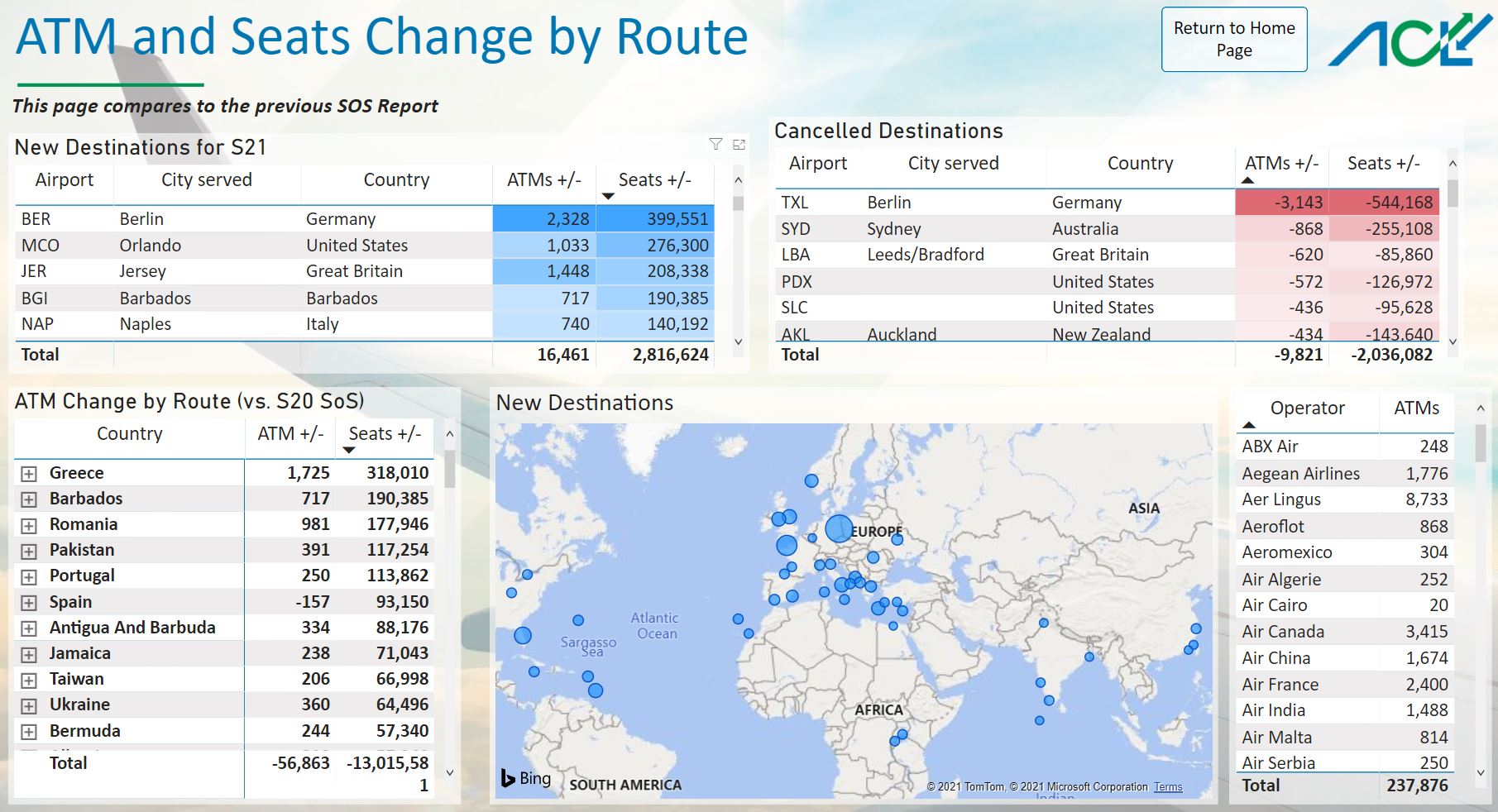
By using the latest PowerBI technology, our data is no longer just numbers on a spreadsheet (unless you need it to be of course!). We can analyse and visualise our data in a multitude of ways, allowing you to share data across your business using easy-to-interpret and interactive visualisations. What’s more, we’re able to feed our data into your systems however you need it, whether that’s via SFTP, CSV, email or downloaded via our online portal OCS. Our team can tailor reports to suit your business, automatically providing the data you need at a frequency and format which suits you.

7-     Its accessible to everyone

ACL provide schedule data to a variety of businesses of varying sizes, from small scale, independent businesses, to companies working across the globe. Data download prices start from under £300 for a single download and ACL even regularly provide industry reports and data analysis articles for anyone to view, free of charge on our website.

8- It’s been essential during the pandemic

In an era of unrelenting uncertainty, airport schedule data has been essential in keeping airport reliant businesses on track. ACL’s automated change reports inform businesses the moment an airline makes a change or cancellation to their schedule, allowing businesses time to adapt their operations, reprioritise their resources and deliver the best service to their customers. With airline schedules more volatile than ever our change reports have been vital in helping businesses to adapt their staffing needs, minimise wastage, process refunds and prioritise savings.

_______________________________________________________________________________

To discover how ACL’s airport schedule data can accelerate your business, get in touch with a member of our expert team today here