30 Years of ACL

This year marks 30 years since ACL began as the World’s first independent slot coordinator. As today marks the start of our next business year, we wanted to share some of our companies highlights, memories past and present, and the expert services ACL offers.

We’ve loved every second spent with our customers. We’re proud of the trust they have placed in us and the determination of our staff to seek the most innovative solutions. From customers who have been with us from the very beginning to our latest newcomers, we’ve loved being your coordinator and we’re excited to serve you for another 30 years…and beyond!

Take a look at our 30th Anniversary page to hear more about our story and 30 years of coordination expertise


Airport Coordination Limited ‘Wellness Walk’ to Benefit Aviation Action

Aviation Action, a charity created to support the aviation industry, have been chosen as the designated fundraising beneficiary of Airport Coordination Limited (ACL) for 2021. ACL, the world’s leading airport slot coordinator, coordinate 46 airports worldwide and are the designated coordinator for UK airports. This year they celebrate thirty years in aviation and will be raising funds for Aviation Action through the fundraising walk ‘Wellness Walk’. On 26th August, ACL employees and members of the Aviation Action board will be walking from London Heathrow Airport to London City Airport, a total of 23 miles.

Supporters of ACL and Aviation Action will be encouraged to make donations through
https://www.justgiving.com/fundraising/aviationactionwellnesswalk – all details can be found on the website.

Chris Wild, founder of Aviation Action said; “We are absolutely delighted that Airport Coordination Ltd (ACL) have chosen Aviation Action as their chosen charity. Our newly formed partnership with such a well-established and widely known aviation business highlights the progress we have made as a charity over the last 12 months. I would like to
thank Neil and the ACL team for their support which will allow us to continue to provide aviation colleagues with dedicated and personal support.”

Neil Garwood, CEO of ACL said, “ACL recognises the incredible work done by Aviation Action during an exceptionally difficult time for aviation, showcasing the dedication, commitment and resilience of our industry. ACL are committed to policies which support greater physical and mental wellbeing in the workplace. We are therefore proud to announce Aviation Action as our chosen charity for the year and are delighted to raise funds for their cause by walking the 23-mile route between two of our customers’ airports.”

Aviation Action relies on donations to provide help and support to people who have had their lives turned upside down through the COVID pandemic. They run peer support programmes as well as provide professional help with mental health, support for job seekers and online events on a variety of topics from finance advice to building up your resilience.

If you are able to make a donation, however big or small, you will be helping to ensure that the services that Aviation Action provide can be maintained into the future. If you would like to donate, please visit the JustGiving page at https://www.justgiving.com/fundraising/aviationactionwellnesswalk

For more information on Aviation Action, please visit www.aviationaction.org

Please follow ACL and Aviation Action’s social pages to keep track of the event

https://www.linkedin.com/company/airport-coordination-limited

www.facebook.com/aviationaction

https://www.linkedin.com/company/aviation-action

https://www.instagram.com/aviation_action/

https://twitter.com/aviation_action

https://www.linkedin.com/company/airport-coordination-limited

ACL Responds to the UK Government’s Consultation on Alleviation for W21

ACL has submitted its response to the UK Government’s consultation on alleviation for the Winter 2021 IATA season.  ACL broadly supports the proposals made by Government (which follow the latest WASB proposal) but with a higher usage ratio and more carefully defined force majeure provisions for Government imposed Covid restrictions on travel.  Any decision to extend alleviation for W21 should be evidence driven and should encourage best use of capacity whilst supporting the recovery of aviation and a gradual return to normal slot rules.  Our full response to the alleviation consultation can be viewed here.

The day aviation’s been waiting for: A first-look at Summer flying as the ban on international leisure travel is eased

After 19 weeks without international leisure travel, today marks the day international holidays can finally resume. Following the government announcement of a UK traffic light travel system, we look at how airlines have responded by adapting their summer plans. 

Ongoing travel restrictions have left the UK’s aviation market substantially reduced, with the first 6 weeks of the Summer 2021 (S21) season seeing an 84% decline in traffic versus 2019 (-42.9 million seats). Reductions in Covid-19 cases and the success of the UK’s vaccine programme have given the industry reasons to be optimistic, however international travel restrictions remain the key factor determining when widespread travel will return.

Airlines have been restricted in their ability to plan for the remainder of this summer, with some operators holding substantial volume for June onwards whilst awaiting decisions on which destinations will be feasible to operate. The 7th May announcement on the UK’s traffic light travel system has provided some clarity in the short-term, enabling airlines to identify which routes can operate with viable seat loads in the coming months. This has driven significant schedule change with seat volumes for June reduced by over 25% since the traffic light system announcement. Airlines have cut back flights based on the traffic light categories, providing a far more reliable schedule picture for May and June.

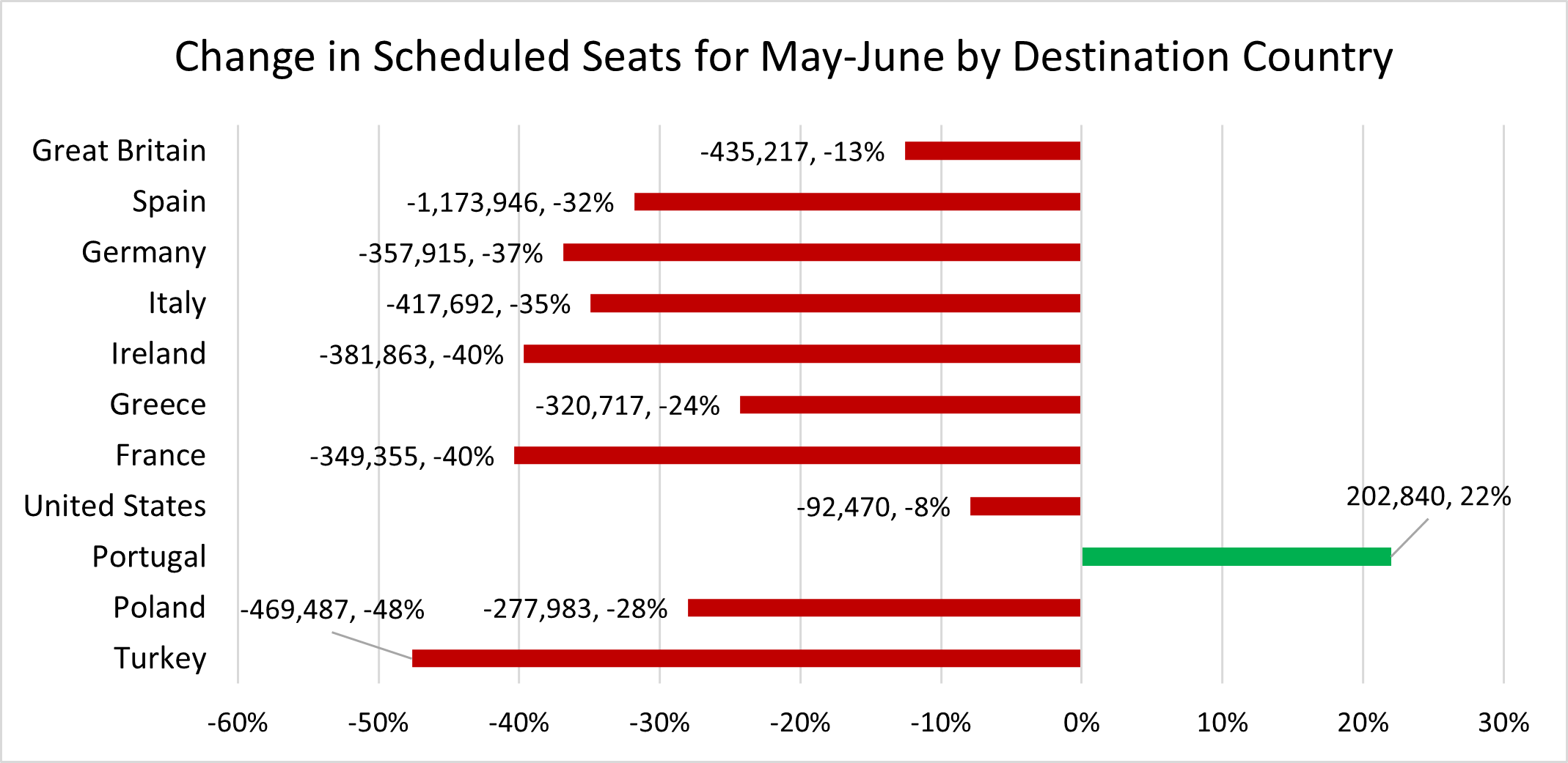
The impact of the government’s system is seen clearly in the changes to slot volume by country, with passenger demand for destinations directly driven by the traffic light system’s travel restrictions. Of the UK’s 20 busiest destinations for May – June, only Portugal has seen an increase in scheduled flights since the announcement, with the other 19 destinations seeing flights reduced or cancelled.


Figure 1 – Change in scheduled seats at ACL UK airports by origin / destination country following traffic light system announcement.


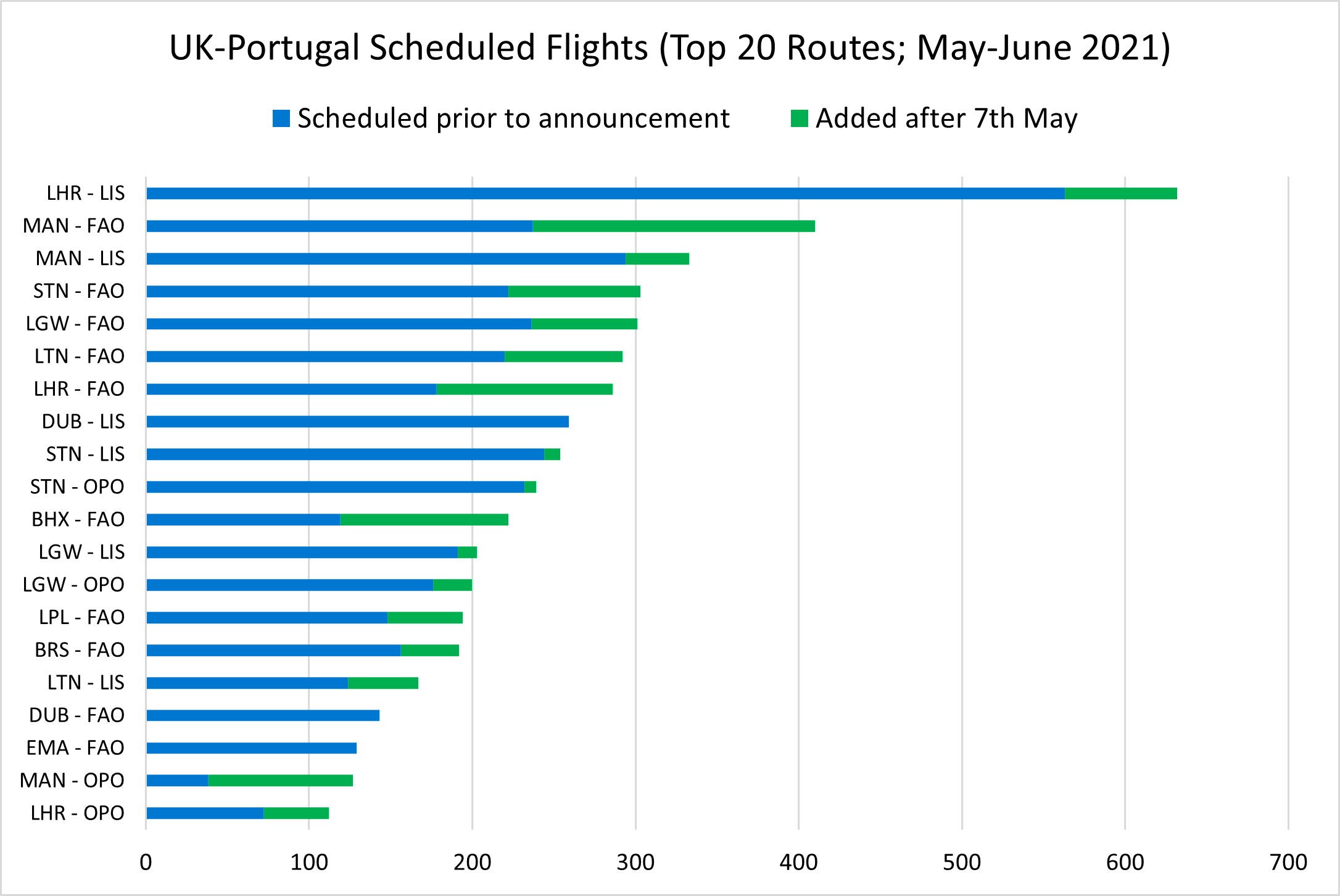
The influence of green-list inclusion on demand is clear; in the week following the announcement of the green-list countries, the number of scheduled flights operating to/from Portugal between May-June increased by over 20%, with over 200,000 additional seats available. Over 1,000 additional flights have been added operating to/from Portugal for May-June, with Faro (FAO), Lisbon (LIS) and Porto (OPO) appearing as the most in-demand destinations for the re-opening of international travel.


Figure 2 – UK-Portugal total flights by route scheduled for May-June 2021 at ACL UK airports.


Flights operating to/from Portugal increased to over 10% of all scheduled international travel for 17th-30th May. This represents a significant increase from 4% of all international flights in S19.

The traffic light system has also driven cancellations for red-listed countries, with the increased isolation period and testing required likely to reduce demand for these routes. Of the busiest UK destinations, the greatest reduction in volume has been for Turkey. Flights for May-June have been substantially cut back (-45%) with 470,000 seats removed from airline schedules. This sharp reduction in capacity demonstrates the impact of the red list requirements on passenger demand, with other operators also indicating they will not be operating flights to/from red-listed destinations.

Airline schedules will continue to develop as further bookings indicate passenger intentions, however ACL now has a far clearer picture of the UK aviation market for this summer. Further changes to the Government’s traffic light lists are likely to trigger more schedule amendments, with the increase in capacity for Portugal giving a clear demonstration of the pent-up passenger demand that exists for S21. Countries added to the green list will likely stimulate an increase in passenger demand, prompting increases in capacity from airlines. In contrast countries moving from green to amber, or amber to red, may see capacity shrink, as demand is reduced due to the additional testing and isolation requirements for passengers. These insights further demonstrate the influence that the UK’s travel restriction system will continue to have on international travel this summer.

By Chris Butler – Airport Capacity Analyst

___________________________________________________________________________________

To access the data behind our reports, or to understand how ACL’s data could help your business make better decisions, please get in touch with us here

Leading in lockdown – a look at Lesley Cowley’s first year at Airport Coordination Limited


Lesley (top right) chairing ACL’s board online back in July 2020


Lesley Cowley began her role as ACL’s new Chairperson in March 2020, bringing with her a wealth of experience as a non-executive director and as Chair of the DVLA, National Archives and Companies House. Lesley became Chair Designate in January 2020, unaware of the events and challenges which lay ahead and that her new role would predominantly involving Chairing a Board online. We sat down with Lesley (virtually) a year on to find out just what it was like Leading in Lockdown.

You began your role as Chair of ACL’s Board when the nation was in its first lockdown, what is it like beginning a leadership role virtually?

I was fortunate to be able to meet Board members and to attend one Board meeting as an Observer prior to lockdown, which was really helpful. My first Board meeting as Chair was a virtual one, but I found people very welcoming and willing to embrace what was to become a ‘new normal’ for many Boards. All of my induction and meetings since then were virtual, so I have missed seeing people in person. I do think you have to work harder to connect with people for the first time in a virtual meeting, as opposed to an in-person one. Virtual meetings are also harder to chair I think.

Last year was one of the most challenging in aviation history, how did your first year at ACL compare with your original expectations?

Last year was indeed incredibly challenging for the industry and for all of us. Like everybody, my original plans and expectations had to change in 2020. I had expected more meetings with staff to learn about their work, to have introductions to key customers and stakeholders and also to attend my first slots conference, but many of those things had to be postponed.  I have had to be flexible and agile and have been very impressed with how agile, adaptable and resilient the team at ACL have been too.

What one thing are you most proud of in your first year as Chair?

Whilst I was sad that our previous CEO decided to move on from ACL to pursue new projects, I am most proud of recruiting Neil, an excellent successor, and bringing in the ‘new CEO project’ on time, in spite of challenging deadlines and the pandemic.

As an independent Chairperson, what benefits/attributes do you bring to the ACL board?

I bring my experience of being a CEO leading a key organisation through growth and challenge over a period of more than 10 years, plus my private and public sector experience as a non-executive director and Chair. This means that I am well placed to provide both support and challenge to ACL and its Senior Team. As an independent Chair, I am able to form a completely fresh and independent view of matters, free from any conflicts of interest.

What attracted to you to ACL?

The opportunity to lead the World’s leading independent airport coordinator and to learn more about how the aviation sector works.

What do you feel is the biggest strength of our company right now?

Our great people and great customer service.

Finally summarise this last year in 3 words:

“You’re on mute”.


Interviewer: Denise Wakeford- Sales and Marketing Lead
Interviewee: Lesley Cowley- Chair of the Board

Further Summer 2021 Waiver Announcement

Following the further announcement on 26th February of the UK’s Secretary of State for Transport that legislation has been introduced (to come into force from 26 March 2021) to extend the waiver from the 80:20 slot usage rule to the Summer 2021 season but now without conditions, ACL has updated its guidance to carriers which you can read here.

Summer Waiver Announcement

The UK’s Secretary of State for Transport has announced that the UK will extend the waiver from the 80:20 slot usage rule to the Summer 2021 season, subject to certain conditions. ACL has updated its guidance to carriers which you can read here

ACL announce new CEO

Airport Coordination Limited would like to inform you that, following a thorough search and rigorous selection process, the Board of Airport Coordination Limited is pleased to announce the appointment of Neil Garwood as our new Chief Executive Officer (CEO). Neil was formerly Managing Director of Southampton Airport, where he had been for ten years, having risen through the ranks after initially joining them as Terminal Operations Manager in 2010.

Neil will succeed Airport Coordination Limited’s departing CEO, Edmond Rose, who is moving on from his role at the end of February. The ACL Board thank Edmond for his outstanding contributions and leadership throughout his time with us and especially through the challenges of this last year.

The Chair of ACL, Lesley Cowley said “I am delighted to welcome Neil to ACL. Whilst our current CEO will be much missed, we are confident that Neil’s experience, drive and values make him an ideal successor to lead ACL as we emerge from the pandemic”.

The new CEO, Neil Garwood said “I am excited to be joining the world’s leading independent airport coordination organisation at a time of seismic change in the industry and very much look forward to continuing to deliver on ACL’s ambition of world class coordination excellence for our customers and stakeholders”.

Neil Garwood, new CEO of Airport Coordination Limited

8 of our Highlights from 2020

2020 wasn’t quite the year we all wanted, but at Airport Coordination Limited (ACL) we’ve chosen to start 2021 by focusing on the positives. We’ve rounded up some of our best bits from last year. Welcome to ACL’s highlights!

  1. Our Industry

    Although 2020 will be remembered as one of the biggest crises in recent aviation history, what last year did demonstrate was the strength and resolve of a passionate industry who can pull together. The support this year from businesses across our trade has been inspiring and we’ve enjoyed collaborating, supporting and working with everyone who has helped us to grow as an organisation over the last year.

  2. Adaptability

    Within a night ACL went from being a face-to-face, office-based organisation to going completely remote. We not only learnt to adjust our individual working styles, but we adapted and grew as a business. We took on a wave of slot cancellations, queries and policy changes which kept our coordinators busy during the pandemic. We saw the best out of our people in 2020 and are so proud how readily they rose to the challenge and adapted to the new norm.

  3. Innovation

    Whilst last year felt like a bit of a set-back, in reality it spurred us to be more innovative than ever. New processes become the norm at ACL. Changes led to major system developments and impressive Power BI achievements. We provided Covid Cancellation reports to our airport customers and industry forums providing them with the data they needed, and we launched our new interactive Start of Season reports, which provided important commercial information and allowed data to be filtered by operators, weeks and routes.

  4. Self-Improvement

    2020 taught us not only to be grateful for our own heath, and the health of our families, but the health of our organisation too. We looked inward and went about improving things within our own business. As a result, scores from our annual staff survey rose across the board. Our overall Engagement measure reached significantly higher than other benchmarked organisations (+15% ) and staff satisfaction improved significantly.

  5. Customer commitment

    2020 made us focus even more on our customers and make sure we were supporting them through some of their toughest times. We were devoted to making sure the service we delivered was as effective as possible, being proactive rather than reactive; responding to their needs; and working together to create new processes, reporting and insights. Each of us experienced, more than ever, the importance of good values, empathy and relationships which we built into the customer service commitments we launched in 2020 which you can view on our website – https://www.acl-uk.org/our-customer-service-charter/

  6. Welcoming new customers to the fold

    This year we welcomed six new airports in Oman to our portfolio; Muscat International Airport, Duqm Airport, Marmul Airport, Qarn Alam Airport, Salalah Airport and Suhur Airport. We also formally began our data collection service at Riga airport and expanded our airport schedule data sales to more ground handling and travel agencies. We look forward to working with each of these customers for years to come.

  7. Expanding our ACL family

    Last year we welcomed two new excellent members to our team, Richard Jones and Wade Chan. They slotted in (excuse the pun) seamlessly and successfully into ACL without ever meeting more than a handful of us in person. Both have brought strong experience with them and made a positive difference to the way we work and the service we provide to our customers.

  8. Some ‘Us’ time

    We pulled out the stops this year to make sure our forced separation didn’t threaten to pull us apart. Virtual Teams meetings, board meetings, even conferences became the norm. ACL pulled together in the background too with regular group games, after work quizzes, a vibrant social feed and even an eventful virtual Christmas gathering.

With 2020 behind us, we are looking forward to supporting our customers through the next year and many more years to come. Though the route may be bumpy, and the destination sometimes unclear, as an industry, we have proven our resolve to get through it together, and at ACL we are determined more than ever to continue delivering coordination excellence.

By Denise Wakeford- Sales and Marketing Lead

A Coordinator’s Guide to Outlasting a Pandemic

Head of Coordination, Richard Cann, explains the background to slot coordination changes because of Covid-19.

I should have guessed back in March that 2020 was not going to be a normal year. My planned holiday around Asia quickly became a beach holiday in Mexico and souvenirs were replaced with bottles of hand sanitiser and toilet rolls. Before flying home, it was clear the effects of Covid-19 were going to challenge aviation’s slot process and may well change it forever.

Operational focus

Slot coordination is a planning function that looks predominately into the medium term. That all changed with the emergence of Covid-19 as the industry shifted into looking at the next few days and weeks. ACL was required to become more operationally focused, to provide information on what was likely to operate in the short term. New processes were adopted to capture & manage repatriation flights and the increase in cargo flights some of which were operating using passenger flights.

Referral processes were introduced where constraint challenges existed. Airlines complained capacity was not available at a time the industry was grounding flights and had few passengers. It took time for airlines to get into a pattern of handing back slots they did not intend to use. In the meantime, ACL had to manage the waitlist as we would in any normal season, with many teams experiencing greater demands on their time.

As the industry becomes more accustomed to the situation a more consistent pattern of slot returns is being seen, albeit still relatively late for those trying to plan capacity and resources. Every new issue of the restrictions led to more changes. Unfortunately, there is unlikely to be any pattern of consistency in the ever-changing environment we are in.

Alleviation

Alleviation must be one of the most used words in aviation this year. With different Regulations governing the slot process in different jurisdictions it was always going to be a challenge to remain consistent across all ACL airports. The EU slot Regulation that governs most ACL airports does not explicitly cover pandemics and the subsequent impact on demand. With Europe having the greatest concentration of coordinated airports, it was imperative that the European Commission acted swiftly to give the certainty the airline community were seeking.

Whilst the EU deliberated, each sector of the industry lobbied ACL to seek alleviation and shared their views on what form that should take. ACL welcomed such interaction, as it allowed us to understand the impact of Covid-19 on different businesses. However, views on what form alleviation should take were wide ranging and often mutually exclusive, which made finding a successful outcome for all parties challenging.

Managing alleviation on a season by season basis means the topic is always on the agenda. As soon as alleviation is granted for one season, the focus moves swiftly onto the next. The Worldwide Airport Slot Board (WASB) aimed to find a consensus between airlines, airports and coordinators. The result of these discussions is a negotiated outcome that seeks to address the concerns of all stakeholders.

Conditions added to alleviation that have been adopted by the EU on a voluntary basis are difficult to administer in a practical way by coordinators, meaning their value is diminished. At a time of crisis, the coordinator needs clear direction with the associated power to deliver successful outcomes. Negotiated outcomes take time and by their very nature can dilute the intentions of what is presented.

Shortly after its establishment, the WASB has been tested with unprecedented circumstances. The challenges of satisfying all requirements will no doubt continue but the focus remains on the speed and quality of the outcomes. If the industry cannot provide effective guidance, there is a risk the Regulator will take a more active role.

New processes

As soon as the impact of Covid-19 was clear, ACL made sure we used the latitude provided in the regulation and WASG to ensure a balanced outcome wherever possible. Throughout, we issued guidelines to airlines to ensure they were aware how slots would be treated during the pandemic. This allowed for newly allocation slots to be allocated on a non-historic basis so new slots did not become blocked season after season as a direct result of alleviation. Such changes required system development to support the coordination team. All of which ACL and its partners achieved efficiently, ensuring we could deal with whatever was presented.

Going forward

The impact of Covid-19 will remain for several seasons. ACL continues to work on ensuring its processes are best placed to deal with the changing environment. Local Rules have been introduced where required to manage temporary reductions in airport capacity. This work has now been incorporated into industry best practice and extended to cover commercial capacity reductions at airports. The teams are now focused on the short, medium and long term to deal with the immediate issues and continue with the scheduling calendar as planned.

In the short term, ACL will continue to lobby for changes to alleviation to close the unintended consequences of blanket alleviation and work on proposals to find an alternative that is more balanced.

ACL believes that there are lessons to be learned from the impact of Covid-19. The standard industry guidelines do not provide for situations that deviates so far from the norm. When a coordinator needs to use the industry guidance in such situations it needs to be clear and not ambiguous.

It is clear, where slots have value (monetary or commercial) there will always be a desire by those that hold them not to give up that position. That is very logical if you are the airline that holds them. For those carriers wishing to access a market, however, this priority is less important, unless they too are protecting a slot holding at their base airport. The basic principles of slot coordination, to facilitate new entrants and promote competition, is difficult to achieve if slots are not returned to the pool. When demand is low, slots would remain in the pool until they are requested by an airline that wishes to operate. But slots are so valuable that no airline will take that risk and if no alleviation is granted, ghost flights become the potential consequence. However, it is important to remember the slot process and regulation does not force flights to operate empty, that is a decision for the airline concerned, in the same way as an airline deciding to operate flights to nowhere.

As we come out of the pandemic, whenever that may be, the industry should review the current contents of the WASG to ensure that it best meets the need of all stakeholders, including those that do not have a seat at the table. The risk of not doing so may result in alternative methods of slot allocation that may be less palatable.

By Richard Cann