UK Alleviation related to fuel related issues: Update on slots returned for NW26.

The UK Government amended the Slot Regulation to permit additional alleviation to manage potential fuel shortages at UK Level 3 Coordinated Airports.

For NW26, carriers are permitted to return 10% of slots subject to certain criteria. The first 5% were to be returned to the coordinator by 15 November 2026. The utilisation of this provision can be found here. A further 5% is permitted to be returned before 14 March 2027.

ACL Guidance related to this alleviation can be found here.

ACL Announces New Head of Coordination

ACL is pleased to announce the appointment of Fernando de Freitas as Head of Coordination, marking the next chapter in a career spanning more than 15 years with the company and over two decades in aviation.

Having joined ACL as a Coordinator, Fernando has progressed through a range of roles across the organisation, supporting airports and projects in the UK, Dubai, Saudi Arabia, Luxembourg, Abu Dhabi and Sydney. His experience provides a strong foundation for leading ACL’s global coordination operation.

As Head of Coordination, Fernando will oversee ACL’s worldwide coordination services, ensuring the continued delivery of high-quality coordination for a growing and diverse customer base.

“The job is very different because it’s more about overseeing the whole delivery of the operation while staying within the regulatory framework and delivering coordination excellence.”

Customer focus and adaptability are central to Fernando’s vision for the role.

“It’s about making sure that we as a team deliver something that our customers are proud of, something where they can really tell the difference between what we are and another coordinator. We’ve got different regulations, different cultures and different requirements. It’s about being adaptable to where we are with our customer profile.”

Looking ahead, Fernando explains:

“There’s opportunity to develop our people within the coordination team and improve customer experience. We can’t just stand still because we’ve done things a certain way for 35 years.”

“We need to support how we make the best use of capacity while contributing to the future direction of slot coordination. Whether that’s artificial intelligence or whatever comes next, we need to be part of that conversation.”

Fernando’s appointment forms part of a wider evolution of ACL’s leadership team following the promotion of Richard Cann to Director of Coordination, where he will focus on the strategic, regulatory and industry developments shaping the future of ACL’s coordination services.

Commenting on the appointment, CEO Neil Garwood said:

“At ACL we’re continually investing in our people, our systems and our ability to keep pace with a changing world. The emphasis we place on training and development is second to none, so it’s great to see these team changes and especially Fernando’s appointment into this leadership role.”

Everyone at ACL congratulates Fernando on his appointment and looks forward to supporting him as he leads the next chapter of ACL’s coordination operation.

UK Alleviation related to fuel related issues: Update on permitted slot returns for NW26

ACL guidance on UK Alleviation related to the fuel situation has been updated to include the number of permitted slot returns for Northern Winter 2026 (NW26).

The UK Government amended the Slot Regulation to permit additional alleviation to manage potential fuel shortages at UK Level 3 Coordinated Airports.

For NW26, carriers are permitted to return 10% of slots subject to certain criteria. The first 5% are to be returned to the coordinator by 15 November 2026.

A further 5% is permitted to be returned before 14 March 2027.

For Northern Summer 2026, carriers can return up to 5% of slots if they are returned before 11 October 2026.

ACL Guidance related to this alleviation can be found here

Inside the Role of a Slot Coordinator

If you ask Jamie Whyte what a typical day as a coordinator looks like, the first thing he’ll tell you is that no two days are ever quite the same.

Working closely with airports and airlines, coordinators sit at the centre of a constantly evolving aviation landscape, balancing demand, capacity and operational requirements to help make the most effective use of airport infrastructure.

“It’s still very much a demand-based role,” Jamie explains. “You’re looking at capacity, understanding demand and working out how everything fits together.”

A typical day can involve analysing schedules, reviewing requests, communicating with stakeholders and responding to changing operational needs. It requires a mix of analytical thinking, problem-solving and relationship management, as coordinators work with multiple parties to understand constraints and identify solutions.

For Jamie, one of the most rewarding aspects of the role is the variety.

“There’s so much to learn. Aviation is such a huge industry with so many different fields and specialisms. You’re constantly learning about something new.”

That exposure provides a unique perspective on the industry. Coordinators work with airports of different sizes, airlines with varying operational requirements and regulatory frameworks that continue to evolve, making every day a learning opportunity. The role also offers a level of flexibility that Jamie values highly.

“In my previous role, I spent much more time in the office. The flexibility here is huge for me. I can plan my time around travel and work in a way that really suits me.”

Despite playing an important role within the aviation ecosystem, coordination remains a career path many people have never heard of.

“I think a lot of people don’t realise that coordinators exist. I didn’t either.”

Yet the skills developed in coordination can open the door to a wide range of opportunities across the industry.

“The good thing about coordination, and with ACL being such a well-known company in our field, is that it opens a lot of different opportunities.”

Former coordinators have gone on to careers in airline scheduling, airport capacity management and business development, taking with them a deep understanding of how different parts of the aviation industry work together.

For anyone considering a career in coordination, Jamie recommends gaining exposure to aviation wherever possible.

“Try and get some experience in aviation, even if it’s minimal. There are so many acronyms, so much jargon and so many different areas of the industry to understand. Getting a foot in the door somewhere gives you a good foundation.”

For Jamie, that’s what makes the role so interesting. It’s a career that combines analysis, collaboration and continuous learning, while offering a front-row seat to the challenges and opportunities that shape global aviation every day.

ACL reaches 80 airport milestone with Bucharest coordination agreement

Airport Coordination Limited (ACL) has reached a significant global milestone with the signing of Bucharest Henri Coandă International Airport (OTP) as the 80th airport in its worldwide portfolio, marking a defining moment in the company’s continued international expansion.
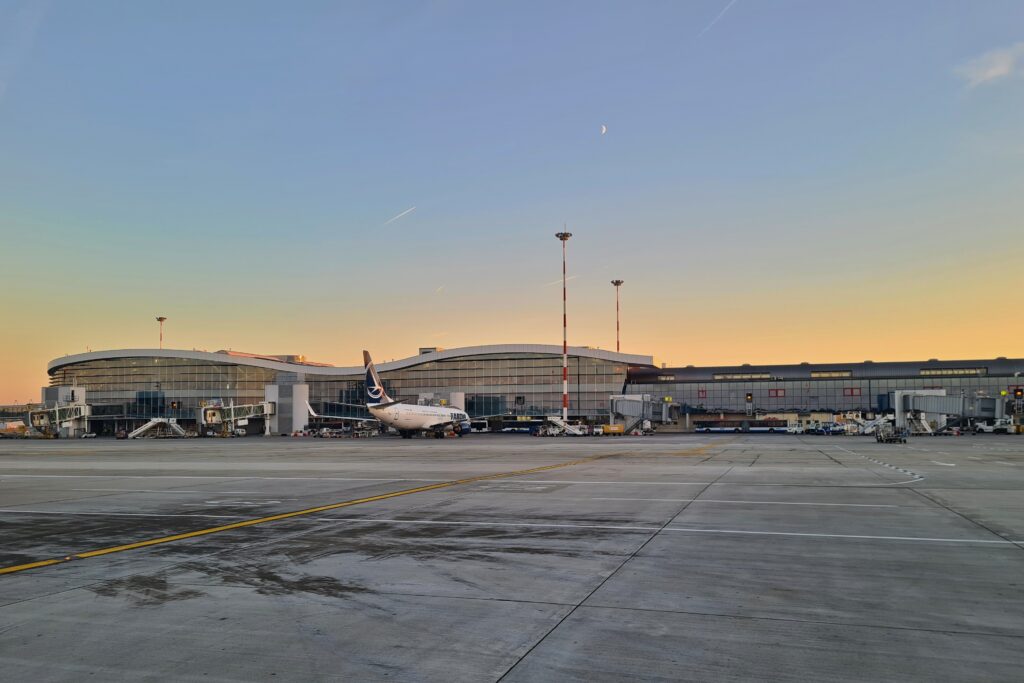
Under a new multi‑year agreement commencing 25th October 2026 for the Winter 26 season. ACL will provide full Level 3 coordination services at Bucharest, supporting one of Central and Eastern Europe’s fastest‑growing airports as it manages increasing demand and plans for its next phase of development. The agreement represents both a significant step in Bucharest’s operational maturity and a landmark moment in ACL’s continued international growth.

Bucharest Henri Coandă International Airport is Romania’s principal international gateway and the country’s busiest airport, handling 17,7 million passengers and 127,7 aircraft movements in 2025. Passenger numbers and aircraft movements have grown steadily in recent years, placing increasing pressure on available capacity. Uniquely, the airport is moving directly from an uncoordinated airport into full Level 3 coordination, having not previously operated under facilitation or formalised data‑collection processes, a transition that marks a significant step change in operational maturity and places particular importance on experience, independence, and proven capability.

The introduction of Level 3 slot coordination represents a fundamental upgrade in how Bucharest operates. Until now, airlines have largely scheduled flights independently, with limited central coordination of how demand aligns with runway, terminal and stand capacity. As traffic has grown, this can lead to congestion during peak periods and less efficient use of infrastructure.

Under Level 3 coordination, all airlines are required to obtain an approved airport slot before operating, with allocations managed independently by ACL in line with EU Regulation 95/93 and globally recognised IATA standards.

This introduces a structured, airport-wide planning process and delivers several immediate benefits:

  • More efficient use of existing infrastructure – Every movement is aligned with declared airport capacity, ensuring optimal use of runways, stands, and terminal resources.
  • Reduced congestion and improved punctuality – Demand is balanced across the day, easing peak pressure and supporting more reliable operations.
  • Fair and transparent access for airlines – Slots are allocated according to internationally agreed rules, ensuring equal treatment of all carriers.
  • Greater operational predictability – The airport moves from reactive scheduling to a coordinated seasonal plan, improving planning for staff, resources and services.
  • A strong foundation for sustainable growth – Capacity can be managed effectively as demand increases, without compromising performance.

This transition effectively introduces a capacity management system for the entire airport, where every flight is planned in advance to ensure infrastructure is used efficiently at all times. For passengers, this means fewer delays and a smoother experience; for airlines, greater certainty; and for the airport, stronger control over its operations and future growth.

ACL’s appointment reflects OTP’s confidence in the company’s ability to support airports at pivotal stages of development. With a global portfolio now spanning 80 airports, ACL will provide transparent, fair and operationally robust slot allocation, helping Bucharest optimise its existing capacity while laying the groundwork for future growth.

Bogdan Mîndrescu, CEO Bucharest Airports said:

“We are delighted to partner with ACL and to become its 80th coordinated airport worldwide. This milestone reflects both the scale of ACL’s global expertise and Bucharest’s commitment to adopting international best practice.

The implementation of Level 3 slot coordination will significantly strengthen how we manage airport capacity, enabling more efficient use of infrastructure, improved punctuality, and a better experience for passengers and airlines alike.

It provides us with a strong and reliable foundation for future growth.”

Neil Garwood, Chief Executive Officer at ACL, said:

“We are delighted to welcome Bucharest Henri Coandă International Airport as the 80th airport in ACL’s global network. This is an important partnership, not only because of Bucharest’s scale and growth, but because it represents a decisive step into coordination at a time of increasing demand. Airports rarely jump straight into full coordination, and doing so successfully requires experience, independence and trust. We are proud that Bucharest has chosen ACL to support this transition and to help lay the foundations for its continued growth and connectivity.”
UK Slot Alleviation Fuel Shortages Update

The UK Government announced over the weekend its intention to manage potential fuel shortages, including allowing airlines to return slots and receive alleviation for NS26.

While the Government has set out its policy intent, any alleviation can only be applied once the UK Slot Regulation is formally amended. A short, targeted industry consultation is expected to take place, after which the Government will finalise the detail and lay a Statutory Instrument before Parliament.

ACL will prepare guidance in readiness for publication once the regulation is amended. Until that point, airlines are advised not to return slots that they intend to seek alleviation for under this announcement and to wait for the amended regulation and accompanying ACL guidance.

Official Government Release

ACL Announces New Chair

The Board of Airport Coordination Limited (ACL) is delighted to announce the appointment of Richard Deakin as Chair, succeeding Lesley Cowley. Lesley departs after six highly successful years, seeing ACL through the pandemic, an increasingly complex regulatory environment, a doubling in customer numbers and a growing presence in new international markets.

Neil Garwood, Chief Executive, said:

“ACL exists to achieve the best solutions for airports and airlines in a fair and independent way, and Lesley’s leadership during the past six years has been crucial as aviation first weathered and then recovered from the pandemic. ACL’s service ethos, improved resilience and international status have all been overseen by her expert influence, and the Board extends its sincere thanks to Lesley for her outstanding contribution during this period.”

Richard Deakin brings extensive experience in aviation and technology, with a proven track record across air traffic management, aerospace, and telecoms. He currently serves as Chief Executive of World Mobile Stratospheric, leading the development of high-altitude platform systems to deliver wide-area 5G coverage. Previously, Richard was Chief Executive of NATS (2010–2015) and held senior roles at Thales, BAE Systems, and GKN.

A Chartered Engineer and Fellow of the Royal Aeronautical Society, Richard holds a first-class degree in Aeronautical Engineering from Kingston University, an MBA from Cranfield School of Management, and an Honorary Doctorate in Engineering from Kingston University. He has served on industry bodies including the CANSO Executive Committee and advises on unmanned aerial systems and traffic management.

Commenting on his appointment, Richard Deakin said:

“I am delighted to be joining ACL as Chair and to be working with Neil and the Board at such an important time for the business and the wider aviation sector. ACL has a strong reputation as the leading airport coordinator, built on principles of neutrality, transparency, and effective slot management. I look forward to building on the excellent leadership that Lesley has provided and supporting the team as we help airports and airlines manage growing demand.”

Lesley Cowley added:

“It has been a pleasure to lead the ACL Board for the last six years, a period of significant change and growth for both the company and the aviation industry. I wish Richard and the team every success.”

Mental Health Matters

Our Head of People, Jon Rowell, discusses why mental health really matters at ACL and why we’ve made it a priority.

View our video on LinkedIn below;


Riga Airport Extends Contract with World Leading Coordinator

We are delighted to announce a continuation of our relationship with Riga Airport! We look forward to supporting this fast-growing Northern European air traffic hub, as they connect the Baltic countries with European business centres and popular holiday destinations.

“We are proud to extend our relationship supporting Riga Airport with its ambitious development plans. ACL unlocks the best use of an airports’ capacity which will help Riga build its role as the region’s premier aviation hub.” Neil Garwood (CEO ACL)

“RIX Riga Airport is pleased to continue its partnership with ACL, the world’s leading airport coordinator. Over the next years, Riga Airport will be investing in significant infrastructure projects to accommodate record passenger numbers. ACL’s expertise in airport coordination will be instrumental in ensuring efficient management of airport capacity during this time of growth and will reinforce Airport’s position as an emerging hub of Northern Europe.” Liene Freivalde (Director of Aviation Services and Business Development Department)

About Riga Airport

Riga Airport is a fast-growing Northern European air traffic hub, connecting the Baltic countries with European business centres and popular holiday destinations. Being aware of its role and responsibility in the national economy of Latvia, Riga Airport develops sustainable services and infrastructure, taking care of its employees and the environment, and keeping pace with society and the local community.

About Airport Coordination Ltd

ACL is the world’s first independent airport slot coordinator, headquartered near London Heathrow Airport. ACL provides world-leading coordination, facilitation, and data collection services at 75 airports across four continents from its offices in the UK, New Zealand and the United Arab Emirates. Coordination at Riga Airport is one of many airports supported across Europe, enhancing ACL’s global position as the world’s leading and largest independent coordinator.