During the current Covid-19 outbreak, ACL is pleased to maintain its full service to customers, continuing to support the aviation industry through the current crisis. In March, we’ve handled more than double the usual number of schedule messages, as well as providing many bespoke reports for airports, support for airport planning and extra reports for data customers.
ACL’s staff will continue to be available during normal working hours for all our offices, whether in New Zealand, the UAE or the UK. We continue to follow official government advice in each country we operate by limiting contact and working from home.
Airport Coordination Limited (ACL) is delighted to announce that it has signed a contract with Oman Airports to provide schedule facilitation at Muscat International Airport and data collection at Duqm, Marmul, Qarn Alam, Salalah and Suhar airports. ACL won the contract through a competitive tender and begins its work on 25 February 2020.
Edmond Rose, ACL’s Chief Executive Officer, met with Sheikh Aimen bin Ahmed Al Hosni, Oman Airports’ CEO, in Muscat to sign the contract on the 24th February 2020. Edmond said, “ACL is proud to be taking over schedule facilitation and data collection at six airports operated by Oman Airports including Muscat and Salalah. We are pleased to bring our vast experience in managing airport capacity, our high-quality customer service and our sophisticated coordination systems to ensure that Oman’s airports can continue to flourish and serve aviation in the Sultanate.”
The contract with Oman Airports is the latest addition to ACL’s activity in the Gulf region. ACL took over schedule facilitation for Abu Dhabi International Airport in September 2019, and also coordinates Dubai International Airport and facilitates the schedule at Al Maktoum International Airport (DWC).
ACL now provides world-leading coordination, facilitation and data collection services at 46 airports across four continents from its offices in the UK, New Zealand and the United Arab Emirates.
Edmond Rose, ACL’s Chief Executive Officer, and Sheikh Aimen bin Ahmed Al Hosni, Oman Airports CEO, signing the contract on the 24th February 2020.
The prospect of an additional runway at London Heathrow has increased the interest in slot allocation within airlines, airports and Government. The Government Green Paper on Aviation included the slot allocation process as an area for consideration. The interest in additional slots at London Heathrow and how they will be allocated, has raised questions of the current slot process and how reform may be required to accommodate the release of significant capacity.
ACL considers these questions and the ongoing debate about the effectiveness of the current approach to slot allocation
Is the current slot regime fit for purpose for the allocation of significant capacity?
Whilst the current EU Slot Regulation[1] and IATA process as detailed in the IATA Worldwide Slot Guidelines (WSG)[2] are not perfect they have provided a sound framework for capacity to be allocated in a transparent, fair and non-discriminatory way.
Taking the single element of allocating new capacity. New entrants have been able to enter new markets and existing carriers have had the opportunity to grow under the current regime at Level 3 airports. Commentary surrounding London Heathrow expansion often focusses on the inability for airlines to gain access and to grow to a level that offers effective competition. That may well be the case but is that as a result of the current regulatory and industry framework?
When comparing London Heathrow Airport to its main competitors in this area, the main difference is that other airports have released capacity and at levels that has allowed airlines to enter and grow. The current slot regime on slot allocation has supported this and has been generally embraced by airlines and airports. London Heathrow on the other hand, has an Air Transport Movement (ATM) Cap of 480,000 movements and high historic demand. This has denied carriers from growing and entering the London Heathrow market due to insufficient capacity in the pool rather than as a result of the Regulatory framework on slot allocation. Had capacity been available then the current allocation method would have facilitated growth and new carriers entering the market in the same way as seen at London Gatwick and London Stansted.
The lack of opportunity to grow or enter an airport is possibly more restrictive than the slot allocation regime itself. The Regulation has allowed carriers to enter new markets and grow where capacity is available.
Development of slot holdings by carrier, London Gatwick, Summer 2000-Summer 2019
Myth – 50% of the slot pool is reserved for new entrants and the remainder for incumbent airlines.
ACL is obliged to follow the EU Slot Regulation when allocating slots. 50% of the slot pool is reserved for new entrants if there is enough demand to utilise the available slots. The Regulation does not stipulate how the remainder of the pool should be allocated other than it should be allocated to applicant air carriers as is the case for new entrants. The Slot Regulation allows 100% of the slot pool to be allocated to new entrants if the Coordinator decides that is the appropriate allocation.
The WSG has recently been updated to be more specific on the share of the pool with 50% of slots being allocated to new entrants and 50% to non-new entrants. Where this is not possible due to insufficient capacity in the pool for example if there is an odd number of slot pairs in the pool, then a 50/50 balance should be achieved over a number of seasons.
ACL is required to give regard to industry standard (WSG) however the Regulation drives the ultimate decision.
Myth – New Entrants are limited to the New Entrant pool
The Regulation sets a threshold of the number of slots an air carrier can hold, above which it no longer benefits from new entrant priority. Any requests that exceed the new entrant allocation can still be allocated as they will be considered alongside requests from other incumbent carriers.
Carriers have the option to apply for new entrant status or not. The Coordinator must take account of that request as presented at the time of allocation based on what was submitted.
Myth – Slot allocations are based on the proportions already held by incumbent airlines.
There is no reference in the Slot Regulation or the WSG that requires the Coordinator to give regard to the percentage share of slots held at the time of allocation. The WSG sets out several secondary criteria[3] including effective period of operation, curfews, competition and requirement of the travelling public to help the Coordinator with its allocation decisions. There is no specific reference to the percentage of slots held.
A carrier holding 50% of the slots at an airport should not assume that they would be allocated 50% of any new capacity released or even 50% of the incumbent pool. Slots will be allocated by applying the primary and secondary criteria which may result in that carrier getting no new slots from the pool.
Slot allocations are not driven by the proportion that a carrier holds but by the substance of the request being made. Such allocations would be made in line with the Slot Regulation and WSG. If a significant incumbent requests a limited number of slots or if other carriers submit requests which make more efficient use of an airport’s capacity to maximise benefits to airport users, the incumbent may be allocated proportionately fewer slots. Conversely, if it submits requests for a larger proportion of slots which make efficient, beneficial use of the capacity, it may be allocated a greater proportion of slots.
Are Coordinators influenced in their decision making?
The Slot Regulation requires the Coordinator to act in a neutral, transparent and non-discriminatory manner. ACL is therefore required to act in that way so has measures in place to prevent undue influence affecting the decision. The greatest deterrent to making poor decisions is the transparency of the process. All stakeholders can see the outcome of every decision ACL makes. Carriers and Airports have every opportunity to question the decision made by ACL and request justification. This is supported by the ability of ACL to be reviewed by the Coordination Committee and ultimately via a Judicial Review.
In preparing for initial coordination, the airport and airlines can explain their business plan to ACL should they choose to do so. This can provide a holistic view of slots requests that can aid a more efficient initial coordination. This process should not undermine the independence of ACL and all decisions must meet the principles of the process.
As the industry approaches the start of a new decade, Airport Coordination Limited looks at the winter 2019/20 season and what is looking like a cautious season for airlines.
Whereas previous winter aviation seasons have seen year-on-year growth, this year’s current picture is one of stagnation for UK aviation, with fewer movements and fewer seats being operated than last winter. Three weeks into the current season (W19), ACL scheduling data allows us to analyse the outlook for UK aviation and highlights an end to the growth that had been seen in recent winter seasons.
Despite the positive growth seen at the initial slot allocation date, currently total airline movements for the 27 UK airports served by ACL are 1.2% lower than last winter. This means that operated and scheduled movements have fallen by over 10,000, with two-thirds of airports hosting fewer flights than last year.
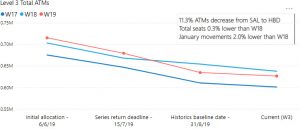
We can view the change in the number of movements at Level 3 coordinated airports over time to observe trends against previous seasons. Level 3 airports currently make up 72% of all movements for W19 and give a good indication of the current season outlook.
There appeared to be some growth for W19 at both the initial allocation date back in June and at the series return deadline in July, however a sharp decrease in movements at the hand back deadline means that the current picture is one of a distinct reduction in movements. Movements fell by 6.6% between the slot return and hand back deadlines; in comparison this decrease was only 2.1% last winter.
Comparing the current trend against previous winter seasons, we can assume that it is likely that total movements will have fallen further by the end of the season due to cancellations and non-operations, despite movements having fallen less significantly since the hand back deadline than seen last winter.
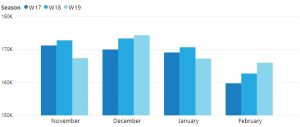
Comparing movements by month shows that the most significant decreases are seen in November and January, driven by decreases in movements at almost all Level 3 airports.
This shows airlines appearing to be cautious in these months, likely due to uncertainty in consumer demand. There also appears to be a greater variation in month to month movements than seen in previous seasons; the growth seen in December and February movements significantly contrasts with the steep decreases seen in November and January. The increased variation in movements by month suggests airlines are targeting months with known higher demand instead of months where demand can be more volatile.
The decrease in movements for the season means that total seats are also currently slightly below figures for last winter. Despite this, average seats per passenger movement has slightly increased by 0.9% to 167 for W19. This indicates that airlines are continuing the trend of upgauging their aircraft across ACL-served UK airports.
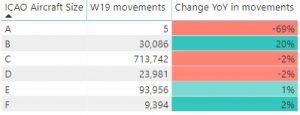
The growth in movements by larger aircraft (Code E and F) contributes to the increase in average seats per movement. It is notable that despite the significant fall in movements by the most common narrowbody aircraft, there is still a growth in movements for the season by the more efficient largest aircraft.
The number of distinct airlines regularly operating slots and the number of different destination airports serviced have both fallen. Whatever the state of Brexit, the origin and destination regions of movements have shown no significant change, with 86% of flights serving European countries.
Overall, the reduction in the number of movements and seats demonstrates stagnation for UK aviation and the effect of uncertainty in consumer demand. The volatility of movements month on month and the cautious approach of airlines contributes to an unsteady outlook for the season. Airlines upgauging aircraft and increasing movements in December and February show that airlines are targeting efficient use of slots and increased activity in periods of typically higher demand.
This winter marks a change in trends for UK airports, but observation of ACL scheduling data throughout the season and looking forward into the summer will show whether this is simply a temporary phenomenon or reflects a change in outlook for UK aviation as a whole.
The Board of the world’s leading airport coordinator, Airport Coordination Limited, is pleased to announce that Lesley Cowley OBE is to become its new Chair succeeding Jeff Halliwell, whose term of office comes to an end in March 2020.
Lesley brings to ACL her wide experience as a non-executive director including chairing the boards of the DVLA, The National Archives and Companies House. In October 2019, she was named as Non-Executive Director of the year in the Institute of Directors (IoD) Awards.
ACL’s current Chair, Jeff Halliwell, commented:
“I’m delighted to be handing over the role of Chair at ACL to an excellent successor in Lesley Cowley. Her strong track record working in bodies with important public roles gives Lesley the right background to take over chairing the Board of ACL as the company prepares for continued regulatory change and commercial growth.”
Lesley said:
“I’m excited to be joining ACL’s Board to help guide the company as it manages the pressures of coordination at a growing number of constrained airports while staying at the forefront of technical progress and customer service.”
Lesley’s appointment will take effect from 1 January 2020 as Chair-designate and she will become Chair when Jeff leaves the role at the end of March.
Edmond Rose, Chief Executive Officer, noted:
“As we look forward to welcoming Lesley Cowley to ACL’s Board, I’d like to record my sincere thanks to Jeff Halliwell for the role he’s played as Chair since 2013, guiding the Board through a period of major development for ACL and its governance.”
About Airport Coordination Ltd
ACL is the world’s first independent slot coordinator, based near London Heathrow Airport and with offices in Auckland, Dubai and Manchester. It supports 41 airports worldwide with coordination, facilitation or data collection, including 25 London and regional airports in the UK; Dublin and Cork in the Republic of Ireland; five airports in New Zealand; Dubai International and Dubai World Central; Poland’s Poznan and Warsaw Airports, Billy Bishop Toronto City Airport and airports in Luxembourg and Vilnius. ACL recently added Abu Dhabi International Airport and is starting data collection for Riga International Airport.
Riga International Airport signs with Airport Coordination Ltd. to manage its schedule data collection.
Riga International Airport, Latvia, has contracted with Airport Coordination Ltd, for data collection services following a competitive tender. The contract commences on September 2019 and it is planned that Airport Coordination Ltd will commence data collection for flights from the end of March 2020, coinciding with the IATA summer timetable.
The number of flights at Riga Airport has increased by 3.8% during the first half of 2019, while the number of passengers has increased by 9,6%.
(Liene Freivalde, Director Aviation Services and Business Development)
“Data collection services at Riga International Airport will help to manage best use of the available airport infrastructure capacity and be ready for the passenger terminal expansion stage 6, under which a new public terminal and the related infrastructure will be constructed.”
Riga Airport is a fast-growing air traffic hub in Northern Europe. The 20 airlines operating at Riga Airport offer more than 90 destinations in the winter season and more than 100 destinations in the summer season. In 2018, Riga Airport serviced more than 7 million passengers and expect to serve 7.6 million passengers in 2019.
About Airport Coordination Ltd
ACL is the world’s first independent slot coordinator, and is headquartered in Staines, Middlesex, near London Heathrow Airport. It supports 41 airports worldwide, including 24 London and regional airports in the UK; Dublin and Cork in the Republic of Ireland; Auckland, Christchurch, Dunedin, Queenstown and Wellington in New Zealand; Dubai International, Dubai World Central and Abu Dhabi Airport in the UAE; Poland’s Poznan and Warsaw Airports, Vilnius Airport in Lithuania, Luxembourg Airport and Billy Bishop Toronto City Airport.
ACL are pleased to announce that Norwich Airport (NWI) have contracted ACL to undertake Data Collection services with immediate effect.
NWI is part of Regional and City airports (Rigby Group) of which BOH and EXT are also existing customers of ACL. NWI airport handles approximately 21,000 ATM’s and 536,000 passengers per year.
NWI is Level 1 Data Collection (SMA) and will be managed by ACL’s Manchester office.
The Government today published its Green Paper on the future of aviation. ACL is encouraged that Government is consulting about a range of possible reform options for the slots allocation system to meet the challenges of today and the future. As the world leading airport coordinator for UK airports, ACL is open to new thinking on allocation to ensure best use of airport capacity, while being keen to ensure that any proposals which are taken forward work practically for our industry.