ACL guidance on UK Alleviation related to the fuel situation has been updated to include the number of permitted slot returns for Northern Winter 2026 (NW26).
The UK Government amended the Slot Regulation to permit additional alleviation to manage potential fuel shortages at UK Level 3 Coordinated Airports.
For NW26, carriers are permitted to return 10% of slots subject to certain criteria. The first 5% are to be returned to the coordinator by 15 November 2026.
A further 5% is permitted to be returned before 14 March 2027.
For Northern Summer 2026, carriers can return up to 5% of slots if they are returned before 11 October 2026.
ACL Guidance related to this alleviation can be found here
Nine out of ten scheduled take-off and landing slots at Sydney Airport were operated in the six months to March 28, according to new data from slot manager ACL Asia Pacific.The Northern Winter 2025 (NW25) end of season report from ACL reveals that total utilisation of slots allocated for Australia’s busiest airport was 95%.
This figure was calculated by combining the 90% of allocated slots flown with the 5% of slots airlines cancelled due to circumstances beyond their control such as war and weather.
Jetstar, Virgin and Qantas, the biggest users of Sydney Airport, operated at close to all their allocated slots, maintaining usage rights for the NW26 schedule, which starts in late October.
It is the first time such detailed slot usage data has been publicly released for any of the world’s major airports, part of the Australian Government’s push to bring transparency to slot management and enforcement practices at Sydney Airport.
The number of operated flights were in some cases heavily impacted by the US-Israel war with Iran through March, when airspace across the United Arab Emirates, Qatar and other Middle Eastern countries closed due to the conflict.
In such cases, impacted airlines – notably Emirates, Etihad Airways, Qatar Airways, Qantas and Virgin – were given slot usage dispensation, allowing them to retain the unused slots for next season.
Airlines that consistently breached the 80:20 ‘use it or lose it’ rule* during the period, without a valid reason, lost the automatic right to that slot in NW26.
Most airlines operated the vast majority of their slots and had retention rates of more than 95%.
At the other end of the spectrum, Tianjin Airlines retained just 33% of its slots, Hong Kong Airlines 71%, and China Eastern Airlines 76%.
On time performance
More than 25% of operated flights missed their slot (a 15 or 30 minute window to either take-off or land depending on sector length) over the period.
Most of these flights were late, potentially disrupting the airport logistics and passenger flow.
International flights were more likely to be on time with 83% of flights landing or taking off within their allocated slot window, while domestic on slot movements were 72%.
The major reason for missing slot windows was airlines arriving late due to consequential delays from previous sectors.
Comment from Darren Batty, Coordination Manager – Asia Pacific, ACL
“Airports need confidence that every available movement is being used effectively. ACL’s approach delivers strong utilisation and operational performance while preserving capacity for future growth – a key priority for airports across Australia,” said Batty.
“At Sydney, we continuously refine how slots are used – aligning schedules, clearing waitlists and responding to operational changes in collaboration with airlines, Sydney Airport and Airservices Australia to deliver strong utilisation and ensure the system remains responsive to demand so that there’s still available capacity for airline expansion.”
*The ‘80:20 rule’ is the global benchmark for slot management. Slots are allocated every six months for the so-called northern summer and winter seasons and an airline must use their allocated slots at least 80% of the time to ensure they retain them at that airport for the next equivalent season. Either use it or lose it.
Leading airport slot manager, Airport Coordination Limited, says 35% of take-off and landing slots during May have been cancelled across the 30 Middle East airports it serves in Dubai, Abu Dhabi, Saudi Arabia and Oman.
This is down on the 54% cancellation rates experienced in through March and April with services at United Arab Emirates airports in Dubai and Abu Dhabi most impacted by the US-Israel war on Iran.
CEO Neil Garwood says: “May already shows 35% of slots cancelled although the actual outcome will be dependent on events.
“The airports furthest from Iran, such as those in western Saudia Arabia, are less affected.”
ACL manages slots at 80 airports in the Middle East, United Kingdom, Europe, Australia and New Zealand.
Garwood says the conflict has caused significant collateral damage in all these markets with surging jet fuel prices and limited supply prompting airlines to raise airfares and cut flights.
“We’ve been tracking airports across 11 countries since the start of hostilities that have experienced varying degrees of disturbance,” Garwood says.
At Sydney Airport, where ACL manages the slots, cancellations for flights to and from the Middle East were 60% in March, increasing to 67% during April.
For May, Middle East slot cancellations at Sydney are currently 32%, a number that may increase during the month.
At London’s Heathrow Airport, where ACL also manages the slots, air transport movements to and from the Middle East fell 47% during March while passenger numbers for the month slumped 51% over the previous year according to airport data.
Middle East slot cancellations at Heathrow during May are, like Sydney, at 32%.
ACL’s Garwood says communication between airlines and the slot manager is crucial during a fast-moving crisis.
“Operators want early clarity around whether their future slot allocation will be protected if they cancel to help with planning and route workarounds,” he says.
“ACL issued tailored guidance to assist airlines with how they could respond to the events within the rules and regulations of each jurisdiction and worked with industry bodies to harmonise this where possible.
“We’ve seen airlines be agile about recycling slots for different purposes. For example, avoiding the Middle East region and putting extra flights on routes as demand patterns change.”
As fighting in Iran and Lebanon has subsided, Garwood says the focus is now on fuel supply and its impact on cancellations.
The prospect of an additional runway at London Heathrow has increased the interest in slot allocation within airlines, airports and Government. The Government Green Paper on Aviation included the slot allocation process as an area for consideration. The interest in additional slots at London Heathrow and how they will be allocated, has raised questions of the current slot process and how reform may be required to accommodate the release of significant capacity.
ACL considers these questions and the ongoing debate about the effectiveness of the current approach to slot allocation
Is the current slot regime fit for purpose for the allocation of significant capacity?
Whilst the current EU Slot Regulation[1] and IATA process as detailed in the IATA Worldwide Slot Guidelines (WSG)[2] are not perfect they have provided a sound framework for capacity to be allocated in a transparent, fair and non-discriminatory way.
Taking the single element of allocating new capacity. New entrants have been able to enter new markets and existing carriers have had the opportunity to grow under the current regime at Level 3 airports. Commentary surrounding London Heathrow expansion often focusses on the inability for airlines to gain access and to grow to a level that offers effective competition. That may well be the case but is that as a result of the current regulatory and industry framework?
When comparing London Heathrow Airport to its main competitors in this area, the main difference is that other airports have released capacity and at levels that has allowed airlines to enter and grow. The current slot regime on slot allocation has supported this and has been generally embraced by airlines and airports. London Heathrow on the other hand, has an Air Transport Movement (ATM) Cap of 480,000 movements and high historic demand. This has denied carriers from growing and entering the London Heathrow market due to insufficient capacity in the pool rather than as a result of the Regulatory framework on slot allocation. Had capacity been available then the current allocation method would have facilitated growth and new carriers entering the market in the same way as seen at London Gatwick and London Stansted.
The lack of opportunity to grow or enter an airport is possibly more restrictive than the slot allocation regime itself. The Regulation has allowed carriers to enter new markets and grow where capacity is available.
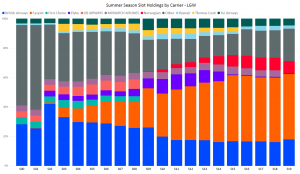
Development of slot holdings by carrier, London Gatwick, Summer 2000-Summer 2019
Myth – 50% of the slot pool is reserved for new entrants and the remainder for incumbent airlines.
ACL is obliged to follow the EU Slot Regulation when allocating slots. 50% of the slot pool is reserved for new entrants if there is enough demand to utilise the available slots. The Regulation does not stipulate how the remainder of the pool should be allocated other than it should be allocated to applicant air carriers as is the case for new entrants. The Slot Regulation allows 100% of the slot pool to be allocated to new entrants if the Coordinator decides that is the appropriate allocation.
The WSG has recently been updated to be more specific on the share of the pool with 50% of slots being allocated to new entrants and 50% to non-new entrants. Where this is not possible due to insufficient capacity in the pool for example if there is an odd number of slot pairs in the pool, then a 50/50 balance should be achieved over a number of seasons.
ACL is required to give regard to industry standard (WSG) however the Regulation drives the ultimate decision.
Myth – New Entrants are limited to the New Entrant pool
The Regulation sets a threshold of the number of slots an air carrier can hold, above which it no longer benefits from new entrant priority. Any requests that exceed the new entrant allocation can still be allocated as they will be considered alongside requests from other incumbent carriers.
Carriers have the option to apply for new entrant status or not. The Coordinator must take account of that request as presented at the time of allocation based on what was submitted.
Myth – Slot allocations are based on the proportions already held by incumbent airlines.
There is no reference in the Slot Regulation or the WSG that requires the Coordinator to give regard to the percentage share of slots held at the time of allocation. The WSG sets out several secondary criteria[3] including effective period of operation, curfews, competition and requirement of the travelling public to help the Coordinator with its allocation decisions. There is no specific reference to the percentage of slots held.
A carrier holding 50% of the slots at an airport should not assume that they would be allocated 50% of any new capacity released or even 50% of the incumbent pool. Slots will be allocated by applying the primary and secondary criteria which may result in that carrier getting no new slots from the pool.
Slot allocations are not driven by the proportion that a carrier holds but by the substance of the request being made. Such allocations would be made in line with the Slot Regulation and WSG. If a significant incumbent requests a limited number of slots or if other carriers submit requests which make more efficient use of an airport’s capacity to maximise benefits to airport users, the incumbent may be allocated proportionately fewer slots. Conversely, if it submits requests for a larger proportion of slots which make efficient, beneficial use of the capacity, it may be allocated a greater proportion of slots.
Are Coordinators influenced in their decision making?
The Slot Regulation requires the Coordinator to act in a neutral, transparent and non-discriminatory manner. ACL is therefore required to act in that way so has measures in place to prevent undue influence affecting the decision. The greatest deterrent to making poor decisions is the transparency of the process. All stakeholders can see the outcome of every decision ACL makes. Carriers and Airports have every opportunity to question the decision made by ACL and request justification. This is supported by the ability of ACL to be reviewed by the Coordination Committee and ultimately via a Judicial Review.
In preparing for initial coordination, the airport and airlines can explain their business plan to ACL should they choose to do so. This can provide a holistic view of slots requests that can aid a more efficient initial coordination. This process should not undermine the independence of ACL and all decisions must meet the principles of the process.